How Château DeFay Grows Wine in Guatemala Without Winter
Wine at 14 Degrees Latitude on the Slopes of Volcán de Agua
Jan de Weerd - Spoken Wines
This will hide itself!
Most vineyards rely on a natural winter. Château DeFay does not have one.
At approximately 14 degrees latitude, on the slopes of Guatemala’s Volcán de Agua, the seasons remain remarkably consistent. The vines receive steady daylight and do not naturally enter the winter dormancy that traditionally resets the growing cycle. At nearly 6,000 feet above sea level, however, Jack DeFay found enough elevation, volcanic soil, and cool mountain conditions to attempt what local experts considered impossible: growing wine grapes commercially in Guatemala.
His solution was not to force Guatemala to behave like California or Europe. It was to invent a new rhythm for the vineyard. After the December harvest, Jack removes the leaves from the vines to mimic winter dormancy. The vines then produce a second, smaller harvest in June. Isabella became the vineyard’s backbone, producing wines with a character that could exist nowhere else.
We first heard about Château DeFay while in Guatemala and brushing up on Spanish in Antigua. The idea sounded improbable enough to investigate. So we climbed toward Volcán de Agua, and found a working vineyard, a complete winery, and one of Central America’s most unusual wine stories.
Watch our video before continuing with the full story: https://www.youtube.com/watch?v=6unYv3vf_xc
Wait… what? There’s a commercial vineyard here, and it is Guatemala’s only commercially operating winery.
That was the rumor I heard while brushing up on my limited Spanish during an immersion class in Antigua, Guatemala.
So on a clear November afternoon, my friend, who had just guided me through the wine regions of his native Hungary, and I left Antigua and climbed the winding road toward the slopes of Volcán de Agua. The air thinned, the views opened, and the landscape shifted into deep volcanic soil that locals proudly say can grow almost anything.
But wine? Hardly anyone would associate this latitude with vineyards.
Here, so close to the equator, sunlight barely changes with the seasons, temperatures stay steady year-round, and vines never sink into winter dormancy, a natural cycle wine grapes traditionally rely on.
And yet, perched at 6,000 feet, there it was: Château DeFay, Guatemala’s only commercially operating winery.
This is the story of Château DeFay.
The Question That Started It All
When Jack DeFay retired after working with USAID and later the World Bank, he came to Guatemala hoping to grow something meaningful.
He first tried the crops local experts recommended, including raspberries, vegetables, and fruits. They all grew successfully. When Jack asked about wine grapes, however, the answer was immediate: impossible.
So Jack planted them anyway.
He experimented with dozens of varieties imported from Washington State, including Cabernet Sauvignon, Cabernet Franc, Syrah, Pinot Gris, and others. Over time, the vineyard showed him which varieties could adapt to the conditions.
During our 2025 visit, Isabella had become the vineyard’s backbone, while Pinot Gris remained under careful experimentation. Fifteen years into the project, what began as a curiosity had become a functioning vineyard on the shoulder of a volcano.
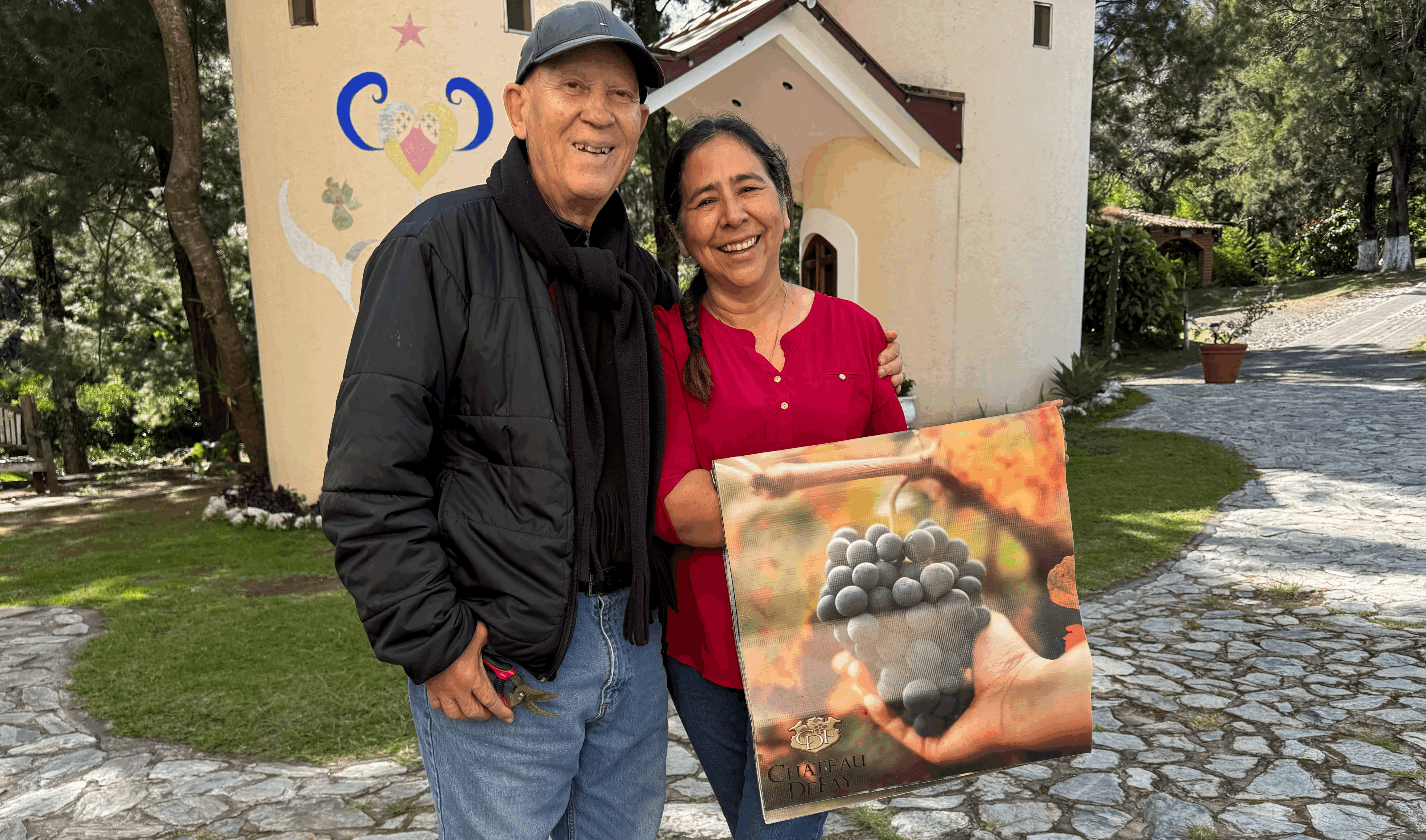
Jack and Jackie went for the ‘impossible’. Starting a vineyard and producing wines in Guatemala.
A Vineyard That Never Sleeps
At 14 degrees latitude, Château DeFay sits in perpetual spring. The vines never fully shut down; winter never comes. So Jack had to invent his own seasons.
How the Vineyard Creates Its Own Seasons
December: Main harvest and leaf removal to mimic winter dormancy
After dormancy: New growth begins
June: A smaller second harvest
Winemaking: Whole-berry fermentation, stainless-steel aging, and limited additions
Core grape: Isabella, selected for its ability to adapt to the site
In practice, that means whole-berry fermentation for six months, punch-downs only during the first five days, slow and cool fermentation in stainless steel tanks at natural temperatures (50 to 70°F), minimal additions of bentonite and enzymes for clarity, small doses of bisulfites, and aging entirely in stainless steel, with oak chips used only when Jack wants a specific nuance.
The resulting wines are unique to this place, shaped as much by necessity as by preference, carrying the sweetness that Jack personally favors. One of the reds, with an amber-tinged hue and gentle residual sugar, felt almost like a tropical spin on tawny port.
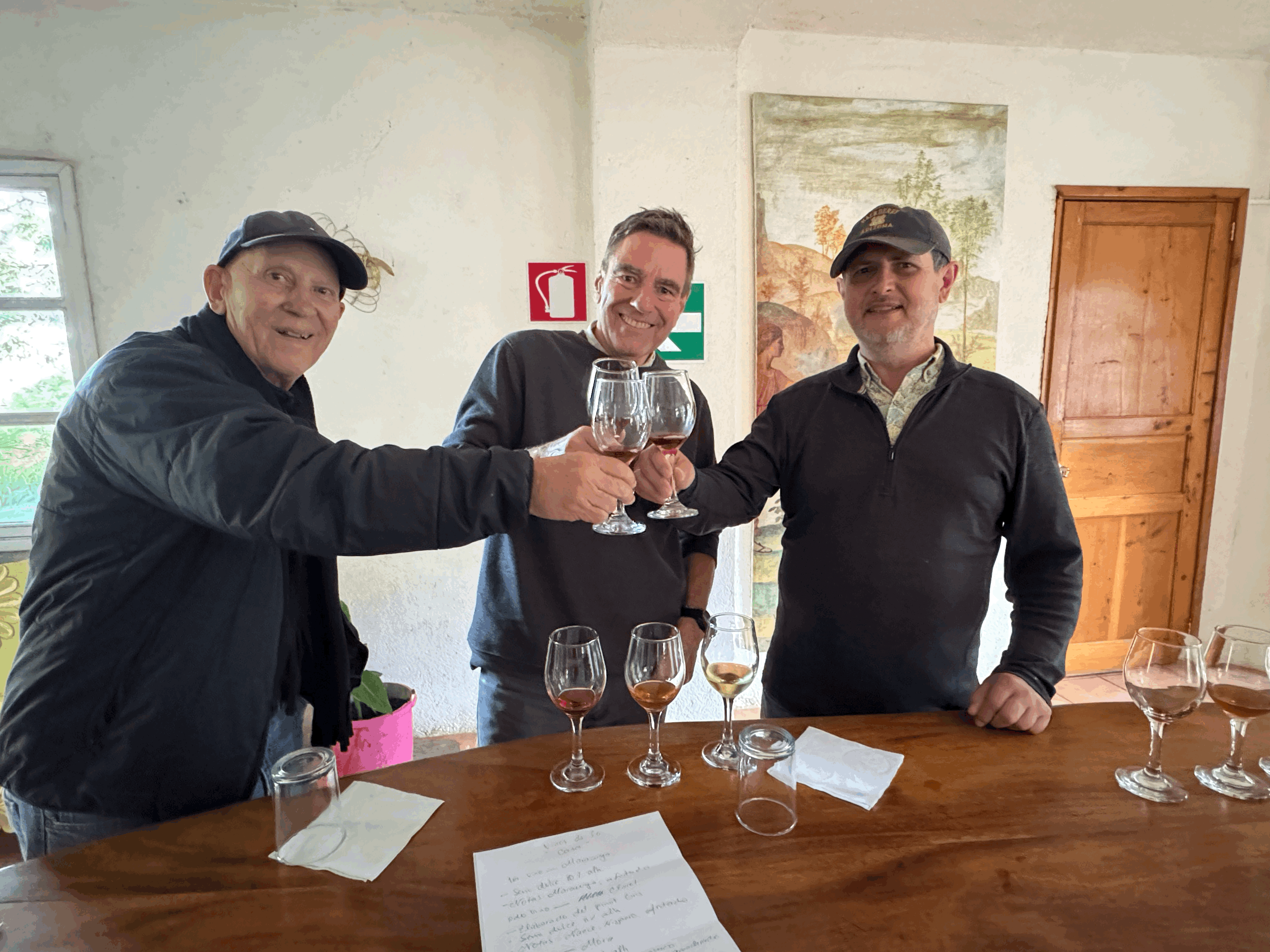
The resulting wines are unique to this place, shaped as much by necessity as by preference carrying the sweetness that Jack personally favors.
Where to Find Château DeFay Wine
Château DeFay wines are difficult to find through mainstream United States retailers. Vivino maintains a Château DeFay producer page where readers can see wines associated with the estate, including Don Jacques Reserva, White Merlot, Claret, Family Red, and Family White.
Explore the Château DeFay wine collection through its Vivino winery page.
This is a discovery page, not a verified purchase or shipping route. Do not assume that the wines are currently in stock or available for delivery to the United States.
If you are traveling in Guatemala, contact Château DeFay directly before visiting. At the time of our 2025 visit, the contact shared for visits and stays was WhatsApp at +502 3768 8353. Confirm that the number and visitor arrangements are still current before making travel plans.
A Living, Evolving Estate
Château DeFay sits on a 48-hectare finca. At the time of our visit, approximately half of the property was dedicated to grapes. The remaining land produced avocados, coffee, corn, and beans.
A complete winery allowed the family to handle the process on-site, from destemming and pressing to fermentation, aging, and bottling. Stainless-steel tanks reflected the same practical approach we saw in the vineyard. Jack worked with the conditions Guatemala gave him rather than trying to reproduce a European cellar.
What began as an agricultural experiment was also becoming a destination. During our 2025 visit, Jack and his wife, Jackie, had spent the previous two years building guest houses overlooking the valley. The accommodations gave visitors a front-row view of one of the world’s most unconventional vineyards.
The project continued to evolve. Jack was still experimenting with Pinot Gris, and every growing cycle revealed something new about cultivating wine grapes at 14 degrees latitude.
At the time of our visit, Château DeFay could be contacted about visits and stays through WhatsApp at +502 3768 8353. Because visitor information can change, confirm current arrangements directly before traveling.
Jack and his wife Jackie have built guest houses overlooking the valley, offering visitors a front-row seat to one of the world’s most unconventional vineyards.
Planning a Visit to Château DeFay
Château DeFay is more than a tasting stop. It is an agricultural experiment, a working winery, and a mountain destination overlooking the Guatemalan landscape.
The estate sits near Santa María de Jesús on the slopes of Volcán de Agua, at approximately 6,000 feet above sea level. It is a natural addition to a stay in Antigua for travelers who want to understand how wine changes when a place does not follow the usual assumptions about where vineyards can exist.
Contact the estate before traveling to confirm whether tastings and accommodations are available. At the time of our 2025 visit, Château DeFay could be reached through WhatsApp at +502 3768 8353.
What makes the estate worth seeking out is not that it resembles a traditional European winery. It is that it does not. The wines are shaped by Isabella, volcanic soil, high elevation, artificial dormancy, and Jack DeFay’s willingness to keep experimenting.
Jack captured that willingness in his own words:
“After 40 years in ‘global investment,’ I am going to try to do something impossible. After I tried four or five different crops, I asked, what about grapes? The guy at the Ministry said, forget it!”
Jack DeFay, founder of Château DeFay
For more firsthand stories from the vineyards and cellars we visit, subscribe to the Spoken Wines newsletter.
More from this country
More stories from this country are coming soon.



From Vineyard to Inbox
Subscribe to our newsletter