Why Daniel Sigmund’s Alto Adige Mountain Wines Taste So Fresh
A first-generation winemaker turns the steep vineyards of the Eisack Valley into Silvaner, Riesling, and Pinot Noir defined by freshness, elegance, and place.
Jan de Weerd - Spoken Wines

This will hide itself!
Daniel Sigmund’s mountain wines taste so fresh because he protects that freshness at every step: farming steep vineyards between 600 and 820 meters, harvesting before the grapes become too ripe, pressing gently, fermenting with native yeasts, and allowing the wines to develop patiently.
His Silvaner and Pinot Noir showed us that freshness is not simply a tasting note. It can be the clearest expression of a place, especially when a young winemaker trusts the mountain vineyards his family has farmed for generations.
“Hi Jan,
Nice to hear from you!
What time are you in our area today?”
That was Daniel Sigmund’s entire reply to my message.
Three short sentences.
Just the kind of genuine response you would expect from someone who was still working in the vineyard when strangers unexpectedly asked if they could stop by.
When we arrived, no one answered our calls. Walking a little farther, I found Daniel’s grandfather peacefully dozing on the porch of the old farmhouse. In my very limited German, I managed to understand that Daniel was still working high above us in the vineyard.
A quick phone call, and a few minutes later he came walking down the mountain. His boots were covered with dirt from the vineyard, and a broad smile was on his face.
As he approached us, I couldn’t help but smile. Here was a young man chasing a dream his family had never pursued before. There was nothing polished or rehearsed about him. Just an easy smile and the quiet confidence of someone completely at home on these mountainsides.
Before we tasted a single wine, I already had a feeling this visit was going to be special.
High Above the Eisack Valley
Most visitors driving through Italy’s Alto Adige region stay on the valley floor. They follow the A22 motorway north toward the Brenner Pass, passing vineyards that seem to cling impossibly to the mountainsides as the jagged peaks of the Dolomites rise dramatically overhead.
Few venture up the narrow roads that wind through tiny mountain villages perched hundreds of meters above the valley. One of those villages is Tschötsch, just outside the historic town of Brixen, also known as Bressanone.
Terraced vineyards appeared between forests of chestnut and pine. Stone farmhouses, some dating back centuries, overlooked the Eisack River far below.
This is not an easy place to grow grapes. The vineyards are steep. Without terraces, some slopes exceed a 50 percent gradient. Everything must be done by hand.
Somewhere in these terraced vineyards was Daniel Sigmund.
Recommended to us by our friend Leonardo from Monte dei Ragni in Valpolicella, we knew almost nothing about Daniel except one sentence:
“If you’re in Alto Adige, you should visit him.”
As it turned out, that recommendation led us to one of the most memorable discoveries of our journey through northern Italy.
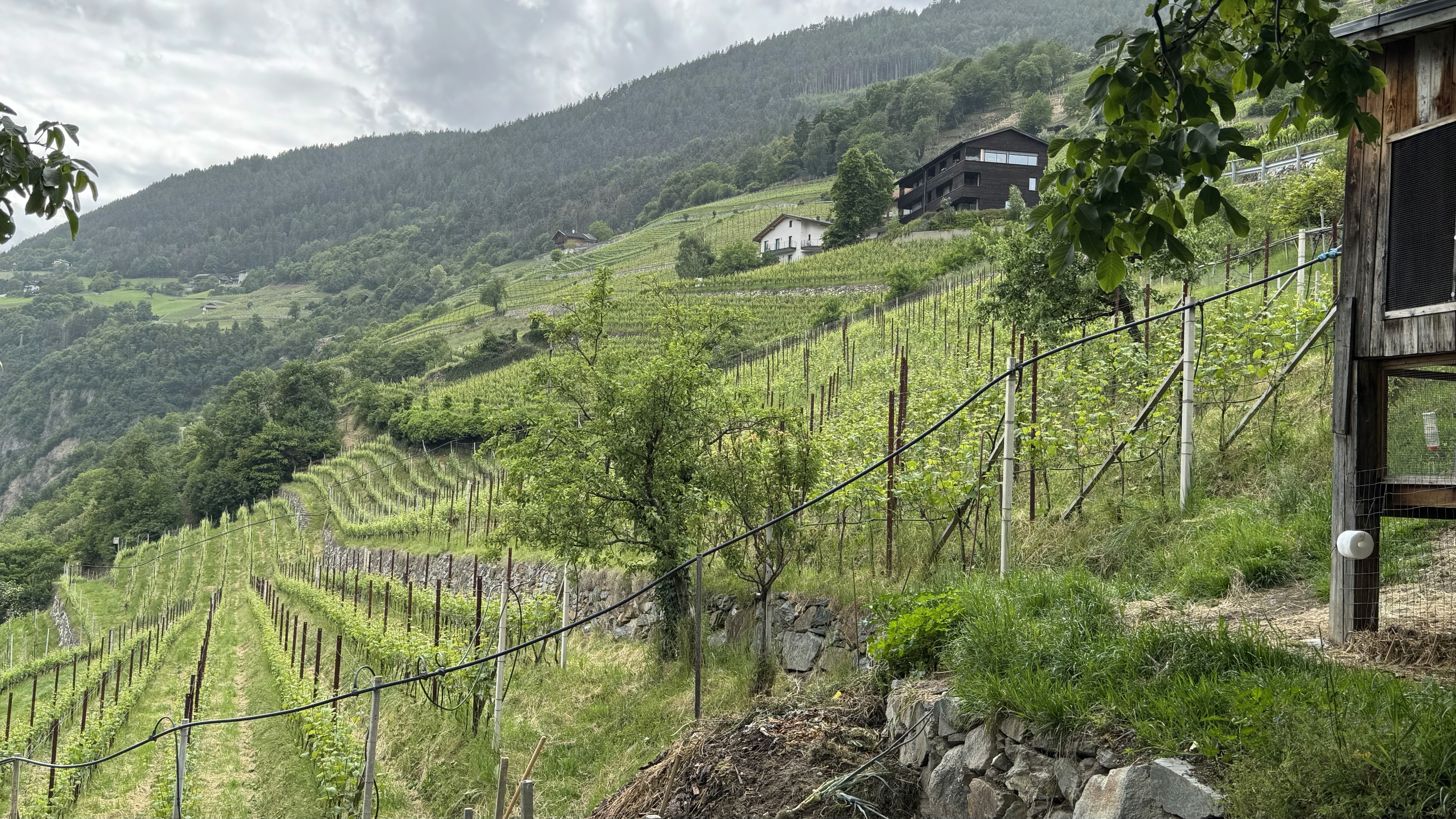
Terraced vineyards and stone farmhouses dating back centuries overlooking the Eisack River far below.
A Century of Growing Grapes, but the First to Bottle His Own Wine
Like many families in Alto Adige, Daniel’s family has been growing grapes for generations. For nearly a century, those grapes followed the same path. They were carefully farmed on these steep mountain slopes before being delivered to the local cooperative.
It is a story repeated throughout Alto Adige, where thousands of small growers cultivate the vineyards while cooperatives transform those grapes into wine.
Daniel fully expected to become part of that tradition. After studying winemaking in Germany, his goal was to become a cooperative winemaker, just like his father.
But while tasting wines from across Europe, he realized that the wines he most enjoyed were different from those being made at home. Without criticizing anyone, he simply said:
“I wanted to make our own product.”
That one decision changed the course of his family’s history.
In 2021, Daniel took over his mother’s vineyards and became the first generation of his family to bottle wine under his own name. Today, he produces just four wines: Silvaner, Riesling, Pinot Noir, and a tiny amount of Portugieser from vines approaching one hundred years of age.

Daniel became the first generation of his family to bottle wine under his own name.
How Daniel Preserves Freshness in the Vineyard and Cellar
Daniel’s vineyards lie between 600 and 820 meters, approximately 1,970 to 2,690 feet, above sea level. They occupy steep mountain terraces overlooking the Eisack Valley.
Warm sunny days are followed by cool alpine nights that help preserve the grapes’ natural acidity. Ancient quartz, phyllite, and granite soils contribute to the elegant mineral character Daniel finds in his wines.
Daniel harvests a little earlier than many of his neighbors because, as he explained, freshness is the most important quality he wants to preserve.
That same philosophy continues in the cellar.
His Silvaner is gently pressed over many hours before fermenting naturally with native yeasts, allowing each barrel to develop at its own pace. His Pinot Noir matures in neutral oak to soften and harmonize the wine before resting in stainless steel, minimizing oxygen exposure and preserving its vibrant, almost reductive character.
Daniel described his Pinot Noir with a smile:
“It’s not a very heavy Pinot Noir. It’s a very elegant, light Pinot Noir… and it’s good like it is because I also drink this wine.”
That simple statement explained a lot. Daniel isn’t chasing bigger wines. He is pursuing purity, elegance, and freshness, qualities that allow these remarkable mountain vineyards to express themselves in every bottle.

Daniel pours his Pinot Noir during a private tasting in the family’s underground cellar.
When Freshness Stands the Test of Time
As Daniel showed us around his cellar beneath the family’s 800-year-old farmhouse, he quietly explained his approach to winemaking. Then he reached for a bottle of Silvaner.
“This bottle has been open for about two weeks,” he said almost casually.
I looked at him in disbelief. Surely the wine would be tired, perhaps even oxidized.
Instead, it practically leapt from the glass. The aromas were vibrant, the fruit was beautifully focused, and the finish seemed to go on forever. Had I tasted it blind, I would never have guessed the bottle had been open for two weeks.
Then Daniel smiled, reached for another bottle, and quietly added:
“This one has been open for about a month.”
Once again, the wine was remarkably fresh, energetic, and full of life.
I immediately thought of something the renowned biodynamic winemaker Nicolas Joly has often said: truly “living” wines seem to retain their integrity long after the bottle has been opened.
Daniel never mentioned biodynamics, nor does he farm that way. But standing in his cellar, tasting wines that seemed almost untouched by time, I couldn’t help thinking back to Joly’s observation. Whether the explanation lies in Daniel’s mountain vineyards, his careful farming, or his patient, low-intervention approach in the cellar, one thing was undeniable: these wines possessed extraordinary vitality.
For me, that became the defining lesson of our visit.
Freshness isn’t simply a tasting note. It is the result of countless thoughtful decisions, from vineyard to cellar, that allow a wine to express where it came from faithfully.
Daniel Sigmund’s wines don’t just taste fresh. They tell the story of the mountains that gave them life.
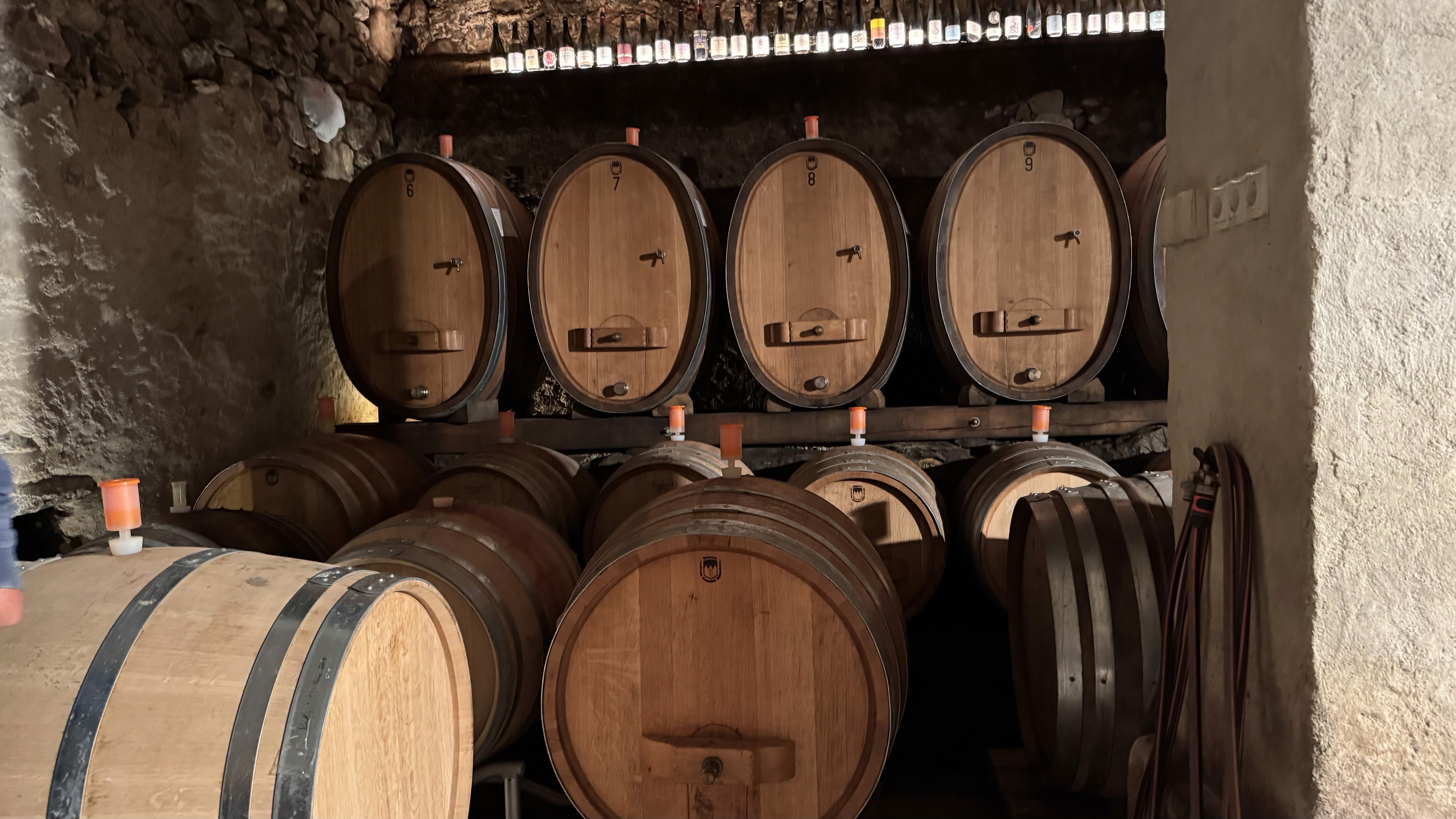
Daniel’s wines mature in wooden barrels inside the family’s underground stone cellar.
Who Should Explore Daniel Sigmund’s Wines?
If you enjoy crisp, mineral-driven white wines, Daniel’s Silvaner is a natural place to begin. It combines alpine freshness with a depth and resilience that became unmistakable during our tasting.
Riesling drinkers will find another expression of the Eisack Valley’s high elevations and stony soils. Those who prefer red wine but do not want heaviness should look for Daniel’s Pinot Noir, a light, elegant wine shaped around freshness rather than extraction.
These are wines for a curious drinker who wants to taste the character of a mountain landscape, not simply the signature of a grape variety.
Daniel reminded us that some of the most exciting discoveries in wine are still found where passion quietly outweighs reputation.
Learn more about Daniel and his family’s winery on the official Daniel Sigmund website, or explore the winery’s current Silvaner, Riesling, Pinot Noir, and Portugieser.
Daniel Sigmund is part of the Alto Adige chapter in our guide to Italy’s key wine regions and where to start, alongside Tuscany, Piedmont, Valpolicella, and Sicily.
“I wanted to make our own product.”
Visit our Italy page to continue exploring the regions, wineries, and people shaping Italian wine.
Keep exploring wine with us. Get firsthand reports from the world’s most remarkable wine regions: join our newsletter.
More from this country

Italy
The Most Important Wine Regions in Italy, and Where Should You Start?
A traveler's guide to the regions, producers, and stories that make Italian wine easier to understand

Italy
900 Years Later, This Winery Is Still Making Some of Italy's Most Remarkable White Wines
How Abbazia di Novacella has balanced centuries of tradition with wines that still feel vibrant, fresh, and unmistakably Alpine.

Italy
The Wines You’ll Never Forget — If You Can Find Them
A journey to Monte dei Ragni, one of the most soulful and elusive producers in Valpolicella.



From Vineyard to Inbox
Subscribe to our newsletter