The Most Important Wine Regions in Italy, and Where Should You Start?
A traveler's guide to the regions, producers, and stories that make Italian wine easier to understand
Jan and Tammy de Weerd - Spoken Wines

This will hide itself!
The most important wine regions in Italy to understand first are Tuscany, Piedmont, Valpolicella, Sicily (especially Mount Etna), and Alto Adige. If you are just beginning, start with Tuscany for Sangiovese, Valpolicella for Amarone, Piedmont for Nebbiolo, Sicily for volcanic wines from Mount Etna, and Alto Adige for some of Italy’s most vibrant mountain wines.
But here’s what we’ve learned after traveling and filming wine regions for more than two decades: Italy can feel overwhelming because every region has its own grapes, food traditions, dialects, and personality. The best way to understand Italian wine is not through memorizing every DOCG or village. It’s through people and place. A bottle becomes easier to remember when you have walked the vineyard, sat at the family table, listened to the winemaker, or tasted the wine where it was born.
This guide is our starting point: the Italian wine regions we would recommend first, the producers who helped us understand them, and the Spoken Wines stories you can explore with the links to the wineries that would welcome you for an initmate, authentic experience.
Start with Tuscany if you want Italy in one glass
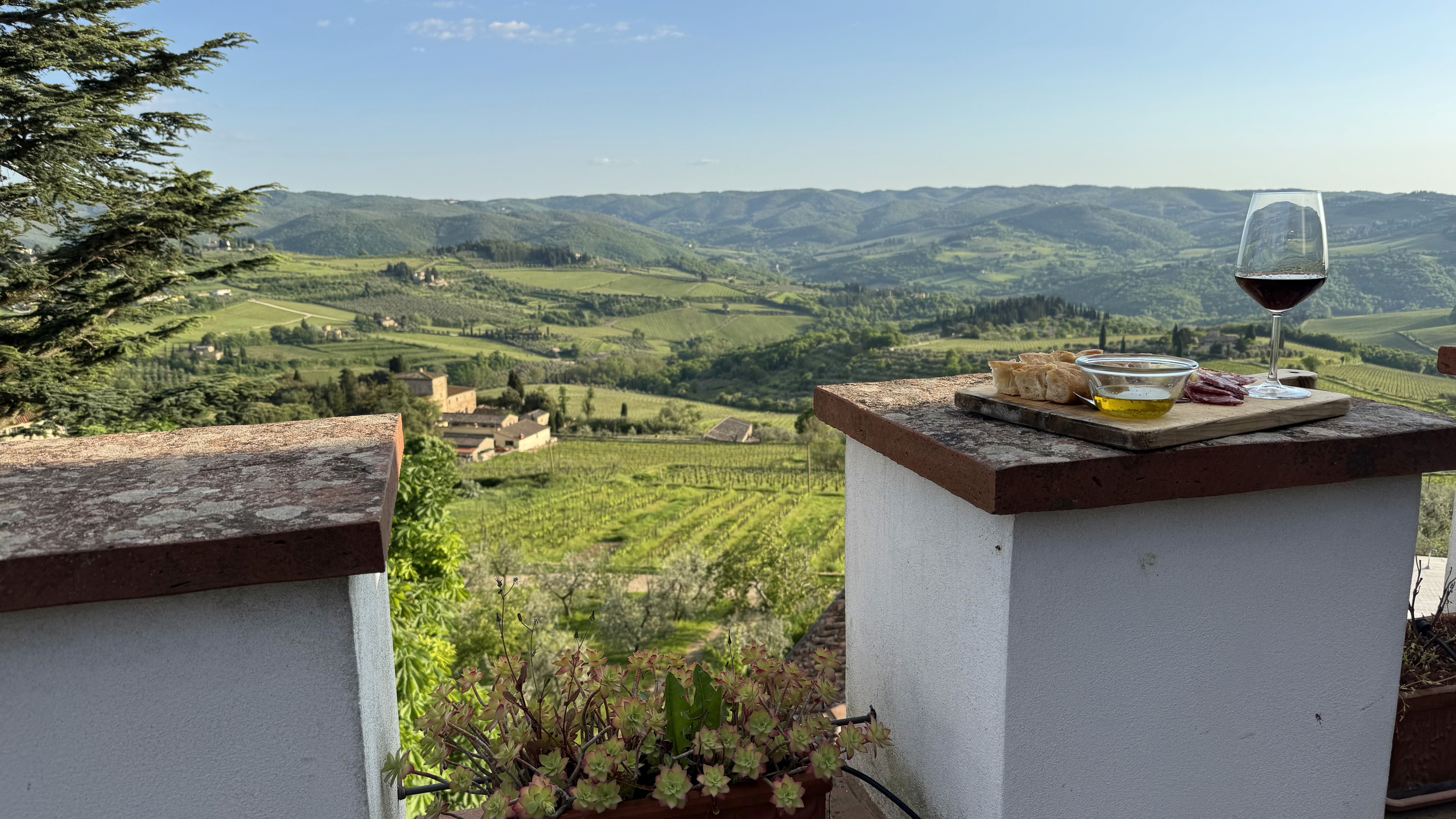
A wine glass and cheese board on a stone terrace overlooking the vineyards of Chianti Classico
For many wine lovers, Tuscany is the easiest and most emotional place to begin. It gives you rolling hills, stone villages, olive groves, long lunches, and Sangiovese in many different voices. But Tuscany is not one single story. Chianti Classico, Montepulciano, and the broader Tuscan countryside each offer a different expression of the land and the people who have stayed close to it.
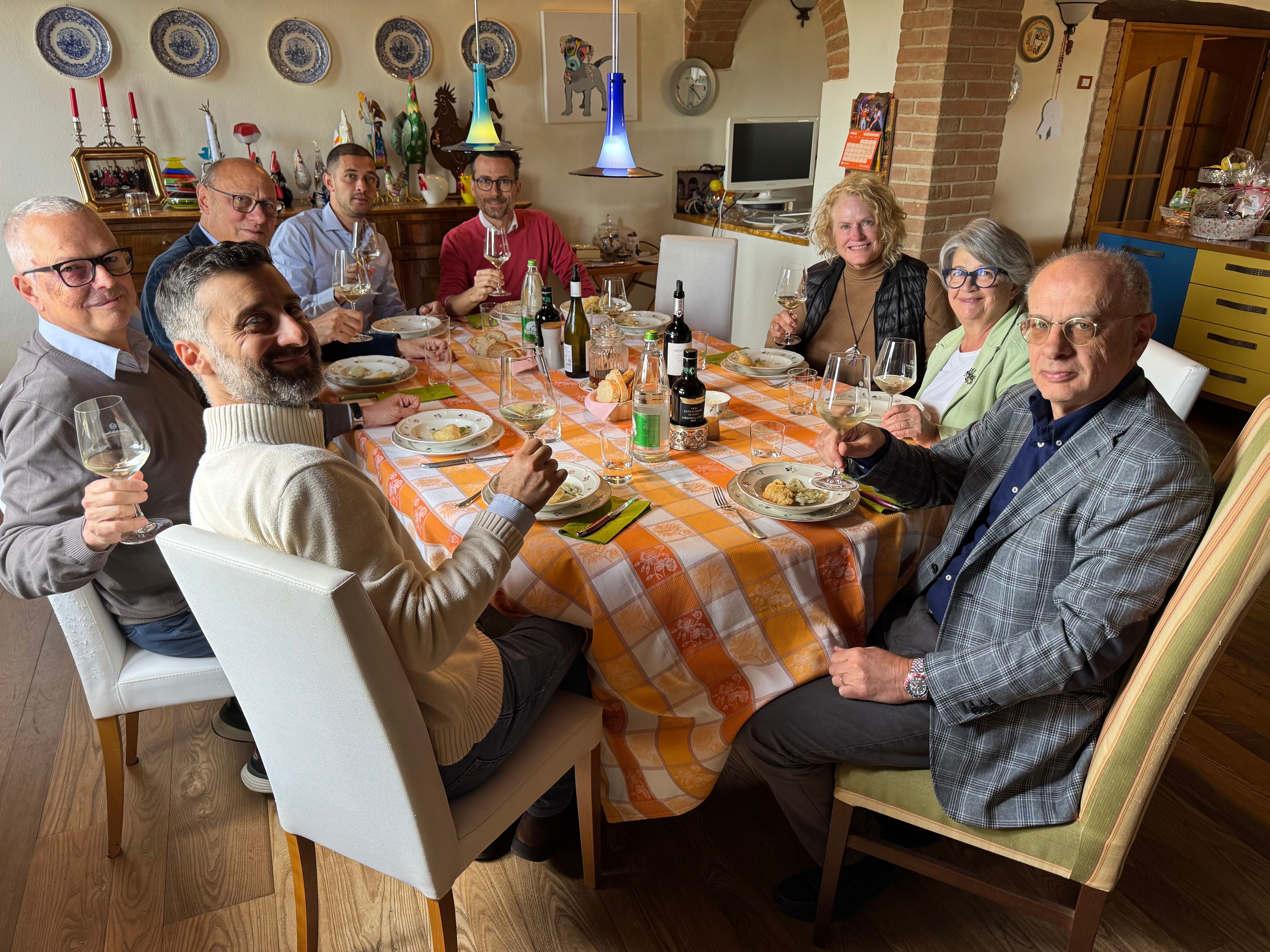
Lunch with Sergio and Daniela Zingarelli’s family at Rocca delle Macìe in Chianti Classico
In Chianti Classico, Rocca delle Macìe gave us a full-circle moment. We had loved their Chianti Classico Riserva for nearly a decade before visiting the estate near Castellina in Chianti. Over lunch at Sergio and Daniela Zingarelli’s family table, surrounded by the people who help carry the winery forward, we understood why the wines feel so generous. The Riserva has always been one of our trusted bottles, but tasting their small-lot Gran Selezione wines, Il Crocino and Sergio Zingarelli, showed us how much depth and precision can live inside Sangiovese.
Tuscany also gave us deeply personal stories: Tommaso Cavalli at Tenuta degli Dei signing a bottle for us during a spring release weekend in Panzano; Gioia Cresti at Carpineta Fontalpino explaining her “sun and moon” vineyards. In Montepulciano, a little further to the east of Tuscany, Susanna Crociani opening the story of her father, brother, and the cellar she never expected to inherit; and Nicolò Trabalzini guiding us through the cathedral-like caves of De’ Ricci deep beneath the city center of Montepulciano.
Just outside Panzano, at Vallone di Cecione, Francesco Anichini helped us understand another Tuscany: the one shaped by hardship, sharecropping, and families who chose not to leave. Around the family table with Francesco, Anna, and Giuliano, we were no longer simply tasting Chianti Classico. We were tasting family history. Francesco told us, “Wine is not just alcohol to drink… you drink the story behind.”
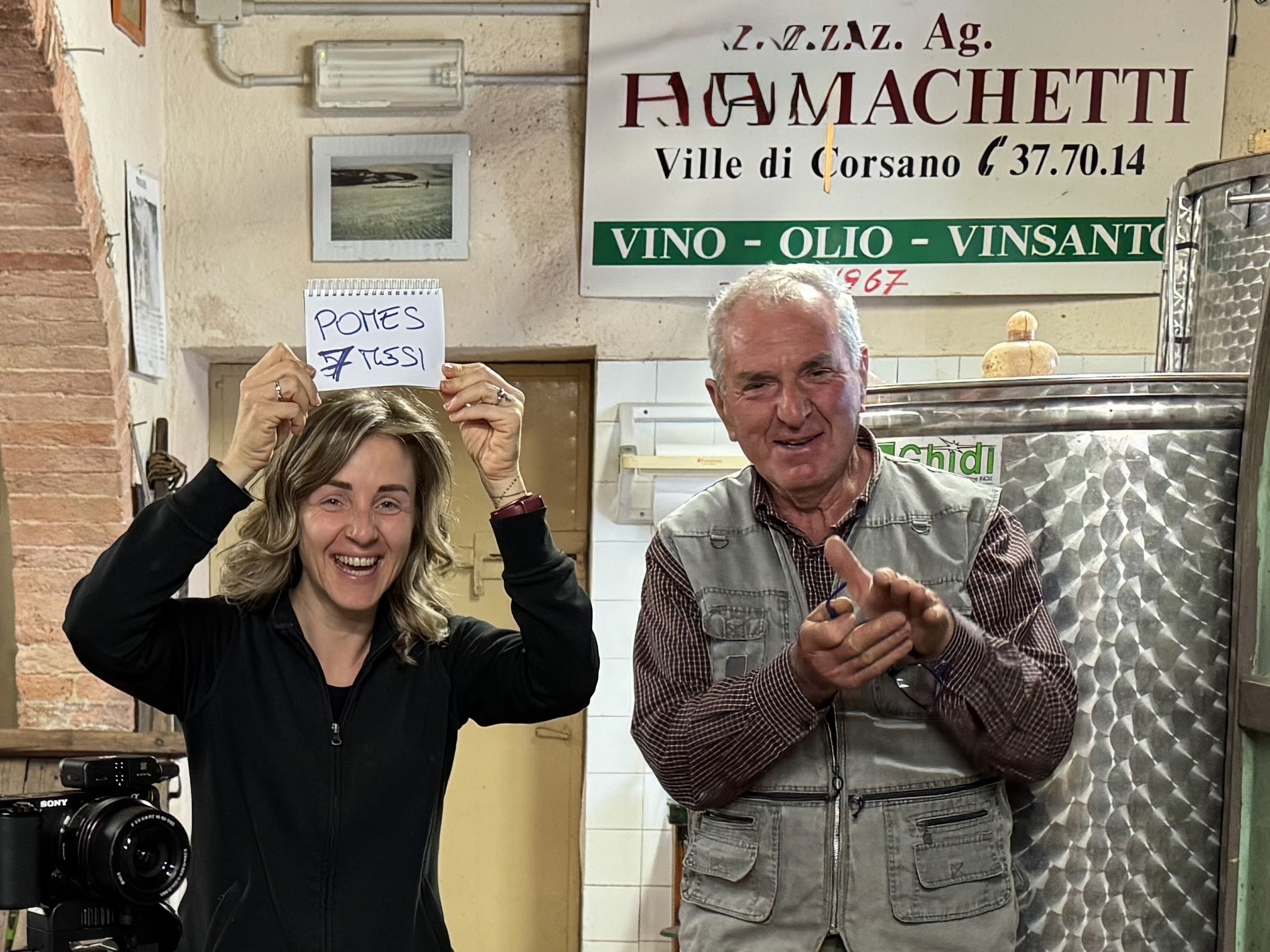
Inside the Machetti family’s cellar in Ville di Corsano, Tuscany
And then there are the quiet surprises. In Ville di Corsano, a simple bottle of 2024 Rosso Toscano from the Machetti family was waiting on the table of our Airbnb. We opened it with bruschetta and expected a pleasant welcome wine. Instead, we looked at each other and wondered, “Where did this come from?” The next day, the family welcomed us into their tiny winery. It sold for six euros. That bottle reminded us that Tuscany’s magic is not always famous or expensive. Sometimes it is waiting on a kitchen table.
Go to Valpolicella when you want Amarone, patience, and depth
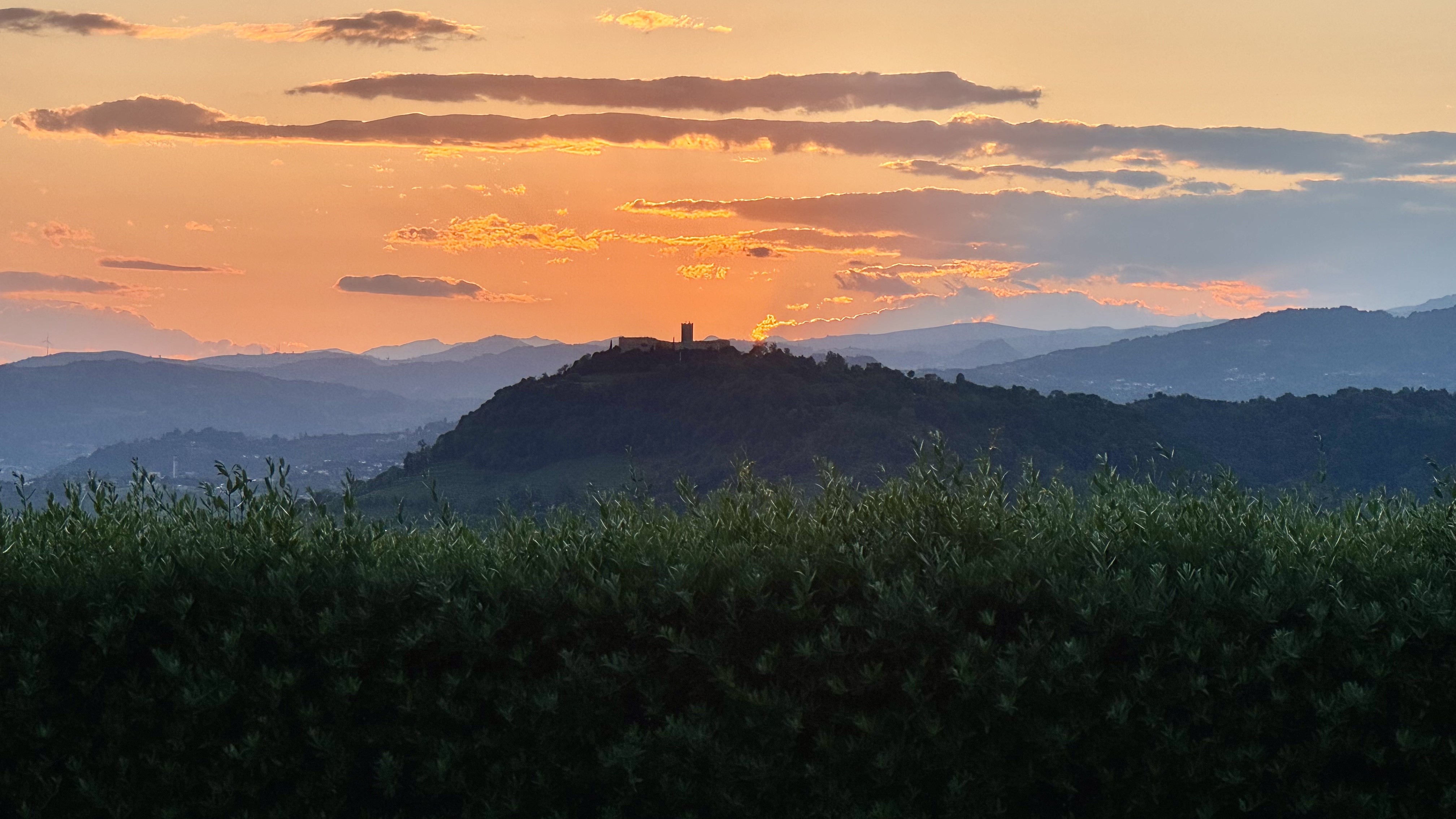
Sunset over the hills of Valpolicella, north of Verona
Valpolicella, north of Verona, teaches one of Italy’s most important lessons: time changes everything. Here, grapes such as Corvina, Corvinone, and Rondinella are dried after harvest through the appassimento process, concentrating flavor, texture, and emotion before fermentation. Amarone can be powerful, but the best examples are not simply big. They are layered, patient, and memorable: wines that reward time in the glass the same way they reward time in the cellar.
Masi and the Serego Alighieri estate brought that history to life for us. Walking the estate in Sant’Ambrogio with Nadia Tomezzoli, we were standing on land connected to Dante Alighieri’s descendants. Pietro Alighieri, Dante’s son, purchased the estate in 1353, and the family story still lives there. Tasting Masi’s Amarone on that ground felt different from opening a bottle at home. The Costasera Amarone, a wine we had trusted for years, felt like seeing an old friend in the place it was born.
Campagnola is another Amarone that has stayed with us for more than a decade. At the estate in Marano di Valpolicella, Camille welcomed us with warmth and pride, sharing the story of Carlo Campagnola and Caterina Zardini, whose name still marks one of the winery’s important wines. Campagnola’s Amarone has become one of our steady cellar companions. We still have vintages from 2012 through 2020 resting at home, each one tied to a memory.
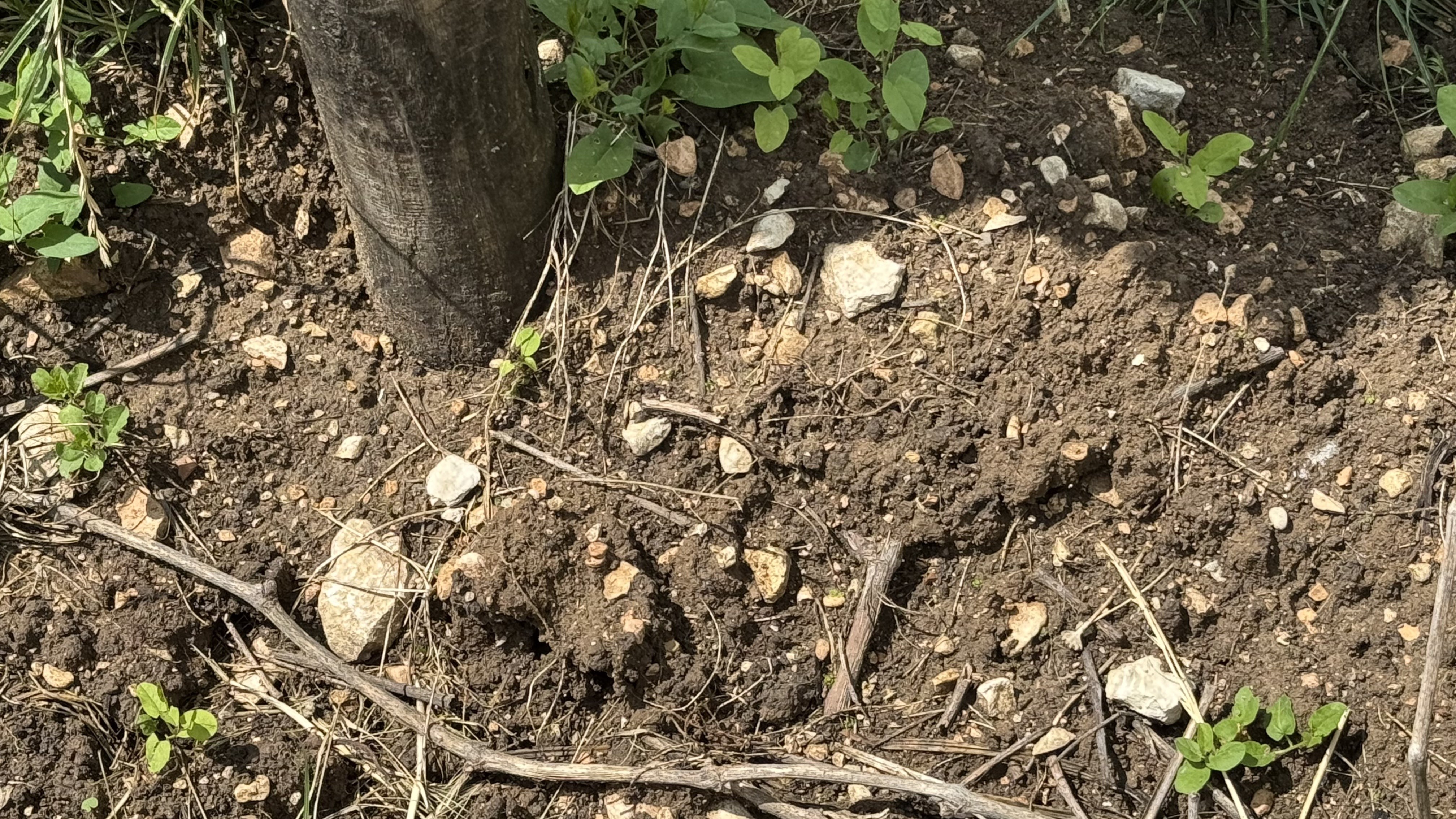
Clay/loam matrix with visible calcareous (limestone) rock fragments is typical of Valpolicella’s soils
But Valpolicella is also where we found quieter, more intimate revolutions. At Monte Dall’Ora, Carlo Venturini and Alessandra Zantedeschi showed us biodynamic farming rooted in balance. “Biodynamics is the only way we know,” Alessandra told us over homemade pasta. At Monte dei Ragni, high above Fumane, Leonardo and Tomasso shared a rare Ripasso found only in special places, yet they poured it beside homemade bread and olive oil. Their father Zeno’s words still guide them: “It’s your wine when you do what you want, when you want.”
Piedmont is where Nebbiolo teaches place, power and elegance
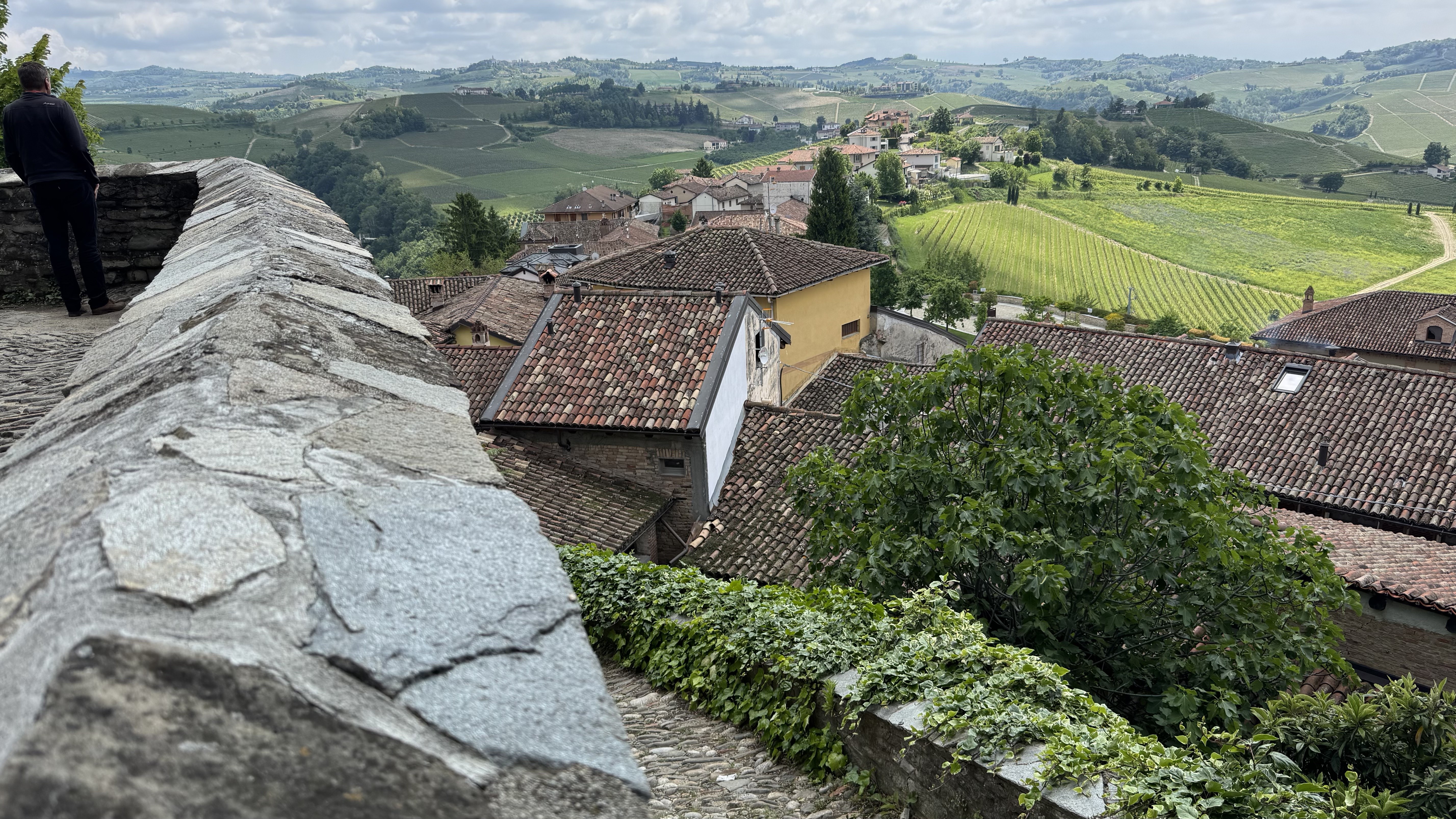
Looking out over the rooftops and vineyards of Barolo, Piedmont
Piedmont is the region we recommend when someone is ready to understand why wine lovers speak about Nebbiolo with such devotion. Barolo and Barbaresco are not always easy at first. They can be structured, floral, earthy, tannic, and slow to reveal themselves. But once they open, they can take you on a long, unforgettable ride. They demand attention, and they reward it.
Our visit to Attilio Ghisolfi in Monforte d’Alba was not planned. It was the day before Mother’s Day, our daughter had joined us from South Africa, and we were wandering through Barolo country when we stumbled onto the winery. A smiling father was doing yard work. The family dog greeted us like we had been expected all along. Davide Ghisolfi poured the wines and talked about learning from his father, Gianmarco. “It’s like school,” he told us. “I learn something new from him every day.” Their Barolo Bussia had so much personality that Jan described it as “Earth, Wind, and Fire.” We shipped a case home to Idaho.
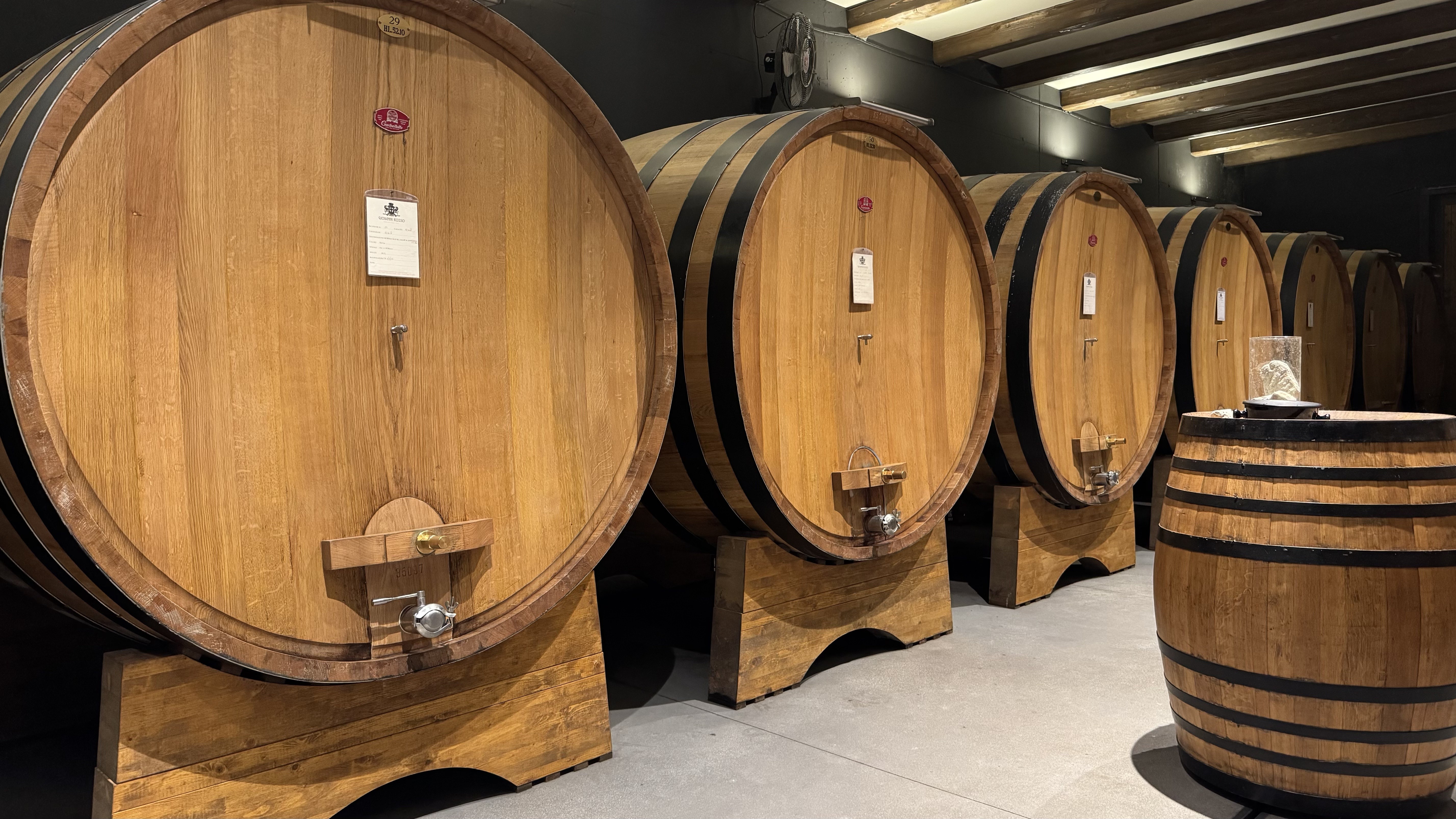
Aging barrels in the cellar at Giovanni Rosso, Barolo
In Barbaresco, the Cortese family helped us understand Nebbiolo through a different lens. Giuseppe Cortese was born in the small house surrounded by the Rabajà vineyard, one of Barbaresco’s most respected crus. His children, Tiziana and Pier Carlo, now carry that story forward with wines that do not feel dressed up or manipulated. In the cellar, Pier Carlo’s approach is traditional and careful: native yeast fermentation, large barrels, neutral amphora, and patience. Their Rabajà Barbaresco felt elegant, layered, and strong-willed, like stepping into a rose garden and riding out on a horse with a leather saddle.
Piedmont is a wonderful next step after Tuscany because it asks a little more from the drinker. It rewards attention. It teaches you that a wine does not need to be loud to be powerful.
Sicily shows the expressive, volcanic side of Italian wine
Sicily is one of the most exciting places to explore Italian wine because it offers contrast everywhere: sea and mountain, heat and altitude, old vines and new energy, ancient grapes and fresh ideas. For us, Mount Etna became the most compelling doorway into Sicily, but the island stretches beyond the volcano into coastal estates, ancient cities, and wines shaped by sea air and Mediterranean light.
Mount Etna is Sicily’s volcanic answer to Burgundy
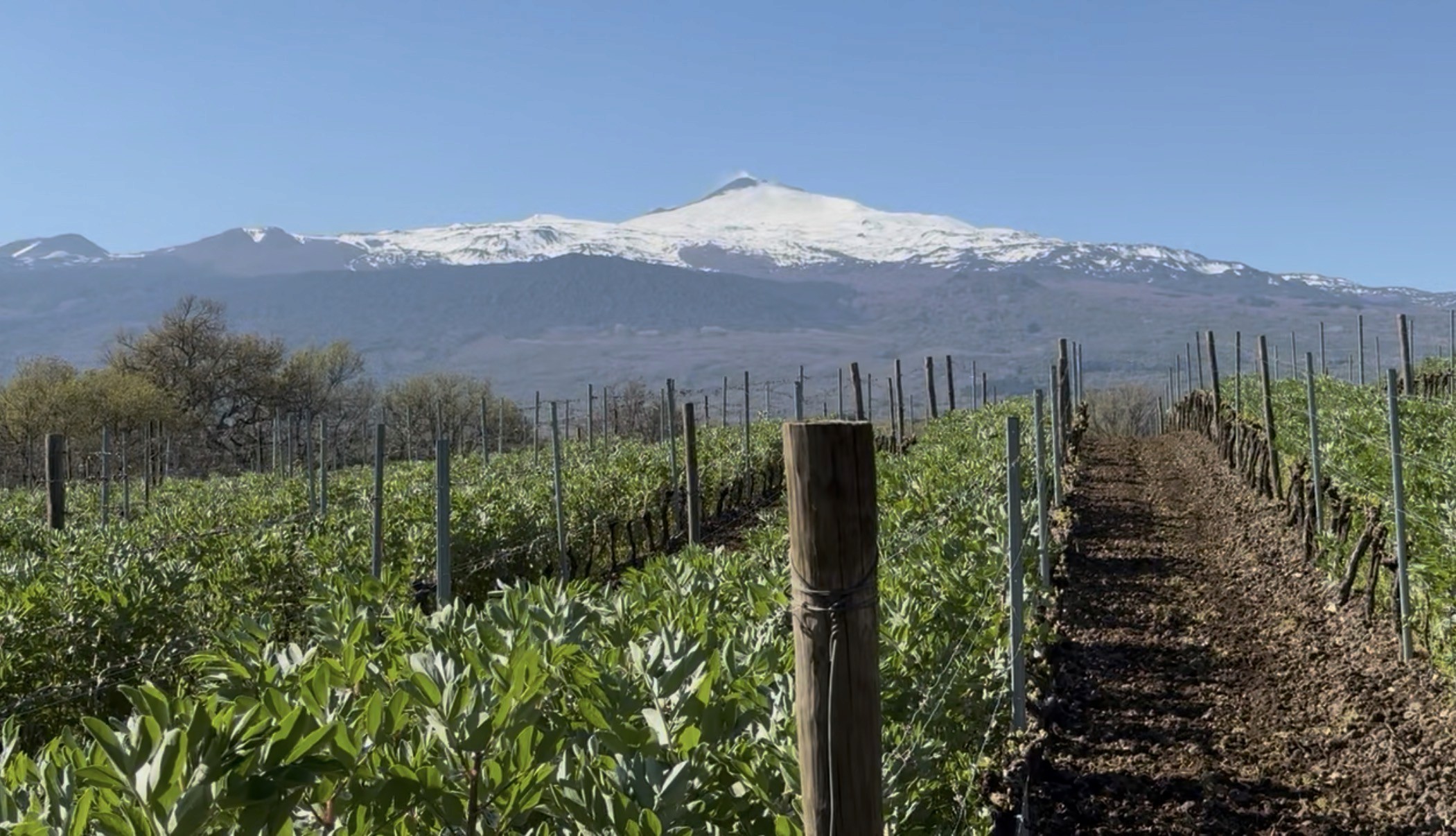
Vineyard rows on the slopes of Mount Etna, with the volcano rising behind
Mount Etna belongs in this guide not simply because it is dramatic, volcanic, and beautiful, but because it is one of the clearest examples in Italy of place speaking through wine. The northern slopes of Etna are shaped by altitude, lava flows, ash, wind, and dramatic shifts in temperature. One vineyard can feel entirely different from the next, much like the climat system of Burgundy, which is why Etna is often described as Sicily’s volcanic answer to Burgundy.
The comparison is not about imitation. It is about transparency. Nerello Mascalese, Etna’s leading red grape, can express volcanic soil with the kind of refinement, energy, and site-specific character that Pinot Noir lovers often recognize in Burgundy. In the hands of thoughtful producers, Etna wines are vibrant, mineral-laden, and deeply connected to the individual slopes and contrade where they are grown.
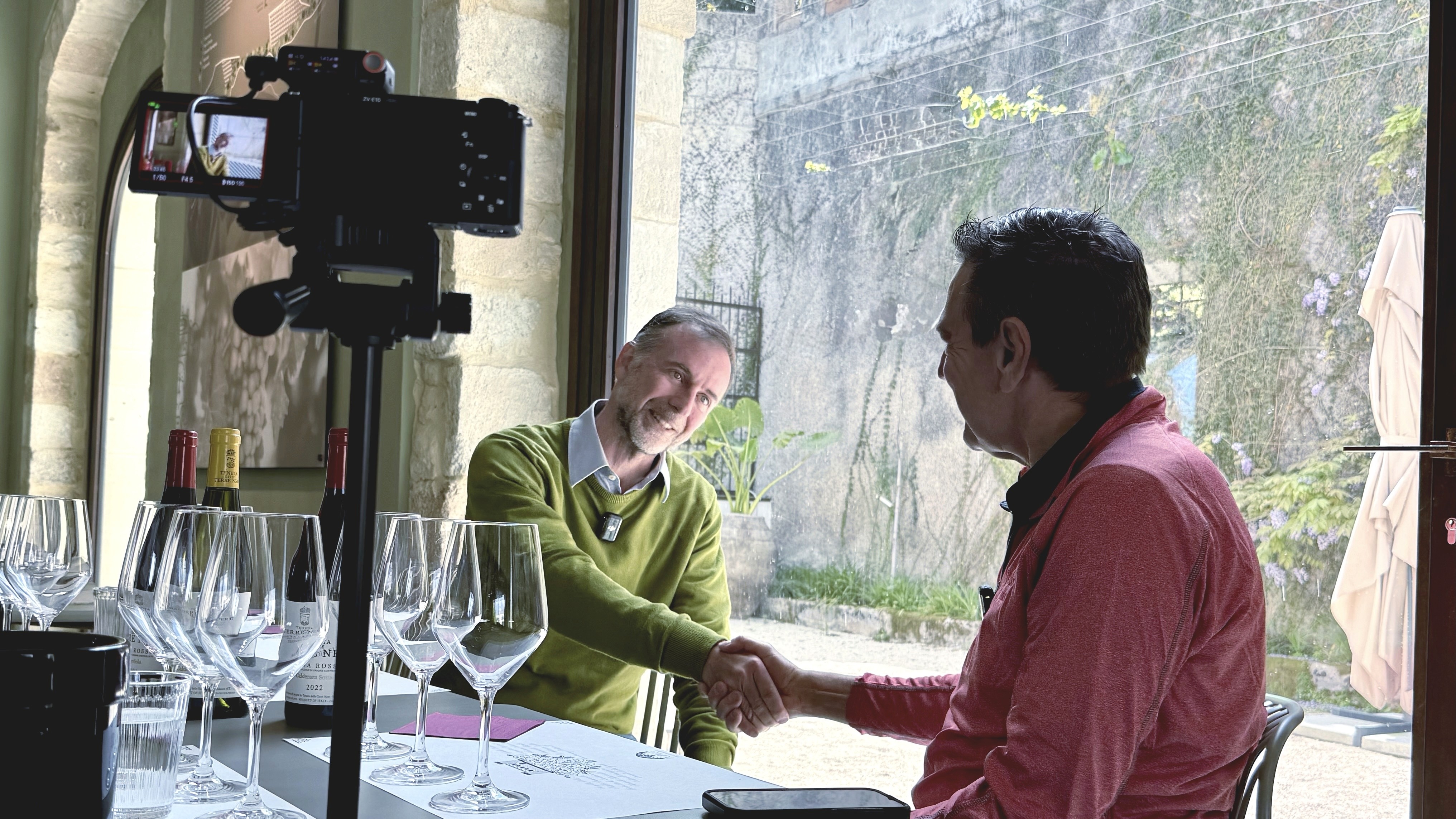
Jan with Christian Liistro at Tenuta delle Terre Nere on Mount Etna
We felt that most clearly at Tenuta delle Terre Nere. Years before we ever visited Etna, we opened a bottle of Guardiola on a snowy December night in Chicago. The wine stayed with us. When we finally sat beneath the volcano with Christian Liistro, we understood why Marco de Grazia saw Etna as a place capable of producing wines with a grand cru vision: old vines, distinct contrade, and volcanic soils that deserved to be expressed parcel by parcel.
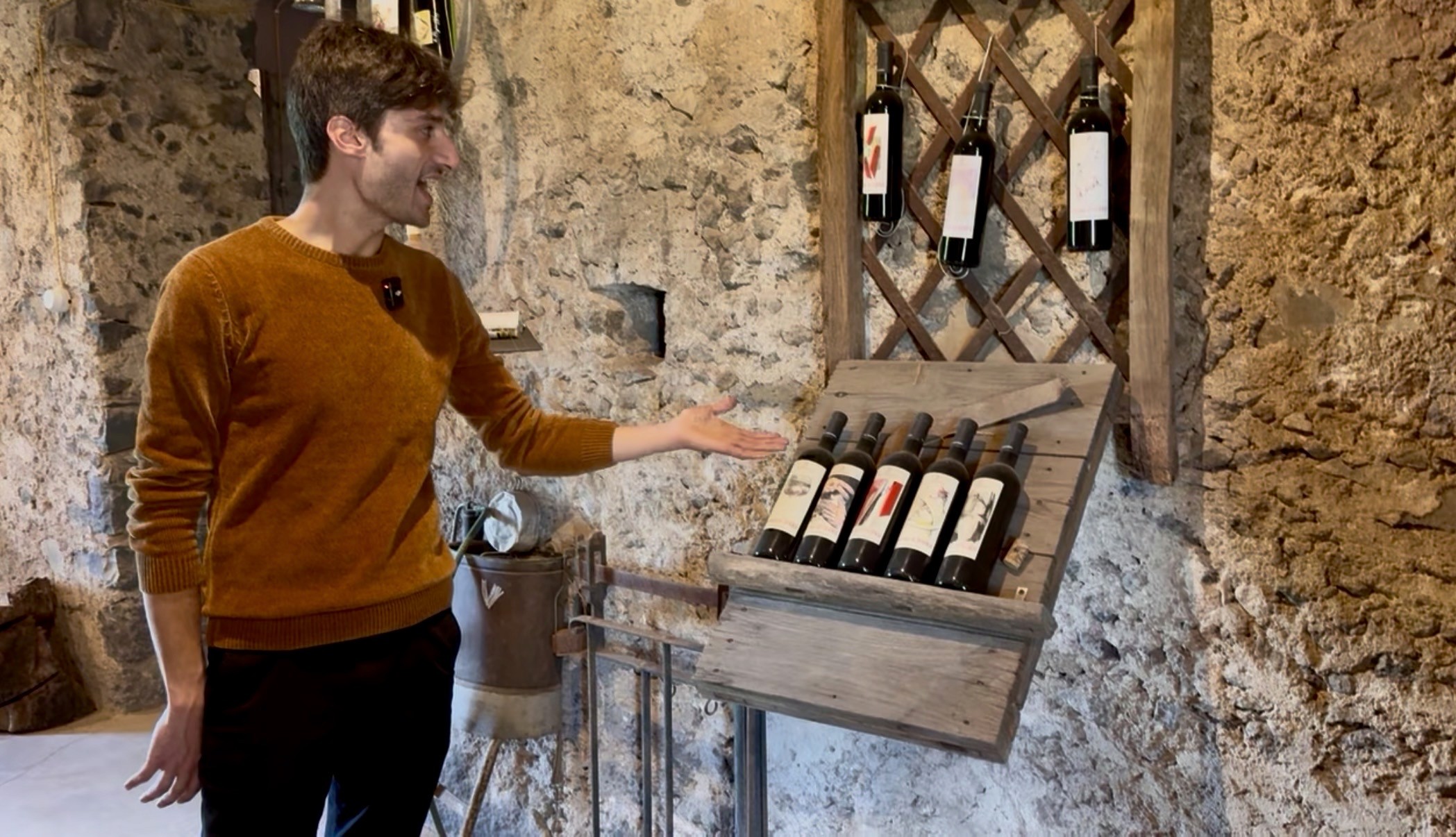
Wines on display in the stone cellar at Al-Cantàra, Mount Etna
At Al-Cantàra, Etna showed us another side of that same volcanic identity. The volcano was breathing that day, with gentle plumes rising into a bright blue sky, while Giovanni Salvo shared wines that brought together lava-rich soils, native grapes, poetry, and art. Their Nerello Mascalese and Nerello Cappuccio carried the grit, beauty, and endurance of the mountain, while the winery’s creative labels and poems reminded us that Etna is not only a place of geology. It is a place of emotion.
For anyone who already loves wine and wants to go deeper, Mount Etna is no longer optional. It is one of Italy’s most exciting regions and a must-visit for the passionate wine pursuer.

Vineyard slopes at Gambino Vini on Mount Etna, with views toward the sea
Gambino Vini showed us the hospitable side of the mountain. What began as neighbors walking up the slope with jugs to buy wine from Vittorio and Maria Gambino has become a place where visitors are welcomed to the table with bread, olive oil, cheese, wine, and a view toward the sea. Their Petto Dragone, made from the best Nerello Mascalese barrels, especially stayed with us.
Sicily also stretches beyond Etna
Sicily is not one story. At Cantine Pupillo near Siracusa, we tasted Moscato di Siracusa beside the historic Castello del Solacium. Their Pollio Moscato, with its mineral freshness and gentle sweetness, sang with a local pepper-crusted cheese. It reminded us that Sicily is an entire world: volcanic mountains, ancient cities, sea breezes, and wines shaped by centuries of different peoples who called this island home.
Alto Adige is where Italy becomes Alpine
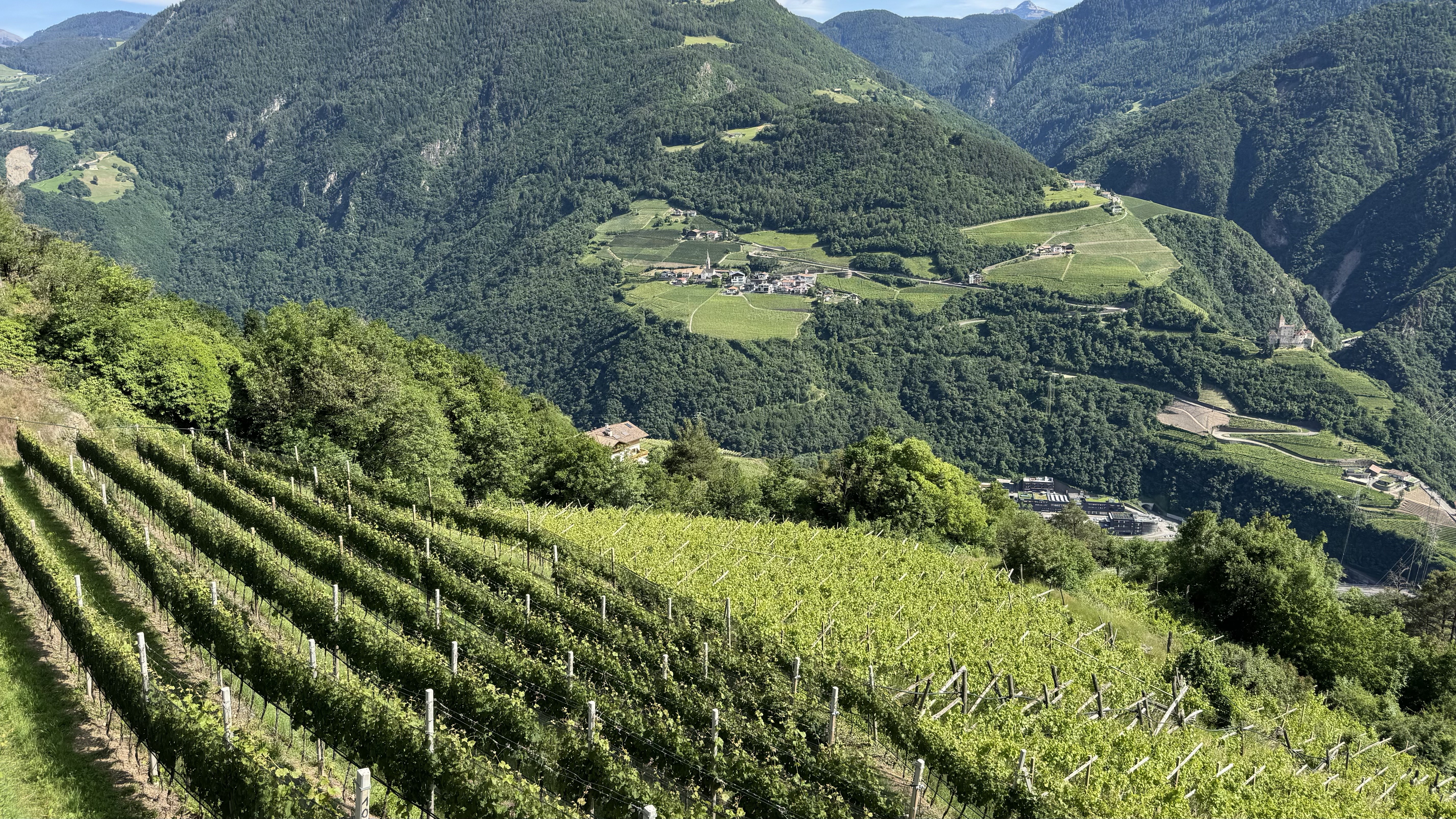
Terraced vineyards climbing the mountainside in Alto Adige
Alto Adige is one of the best places to start if you love white wines with freshness, clarity, and mountain energy. This is northern Italy, where vineyards climb steep slopes, the Dolomites rise dramatically in the distance, and warm sunny days are followed by cool alpine nights. The result is wine that often feels lifted, precise, and alive: white wines that do not apologize for being delicate.
Abbazia di Novacella was our doorway into the region’s long history. Founded in 1142, this Augustinian monastery has been connected to wine for nearly 900 years. But what impressed us most was not simply its age. It was the way the wines still felt vibrant. During our tasting, the Sylvaner stayed with us most. It was elegant without trying to impress, with orchard fruit, floral notes, and a mineral backbone that seemed to echo the mountains around us. The Moscato Rosa was another surprise: sweet, yes, but fresh and beautifully balanced.
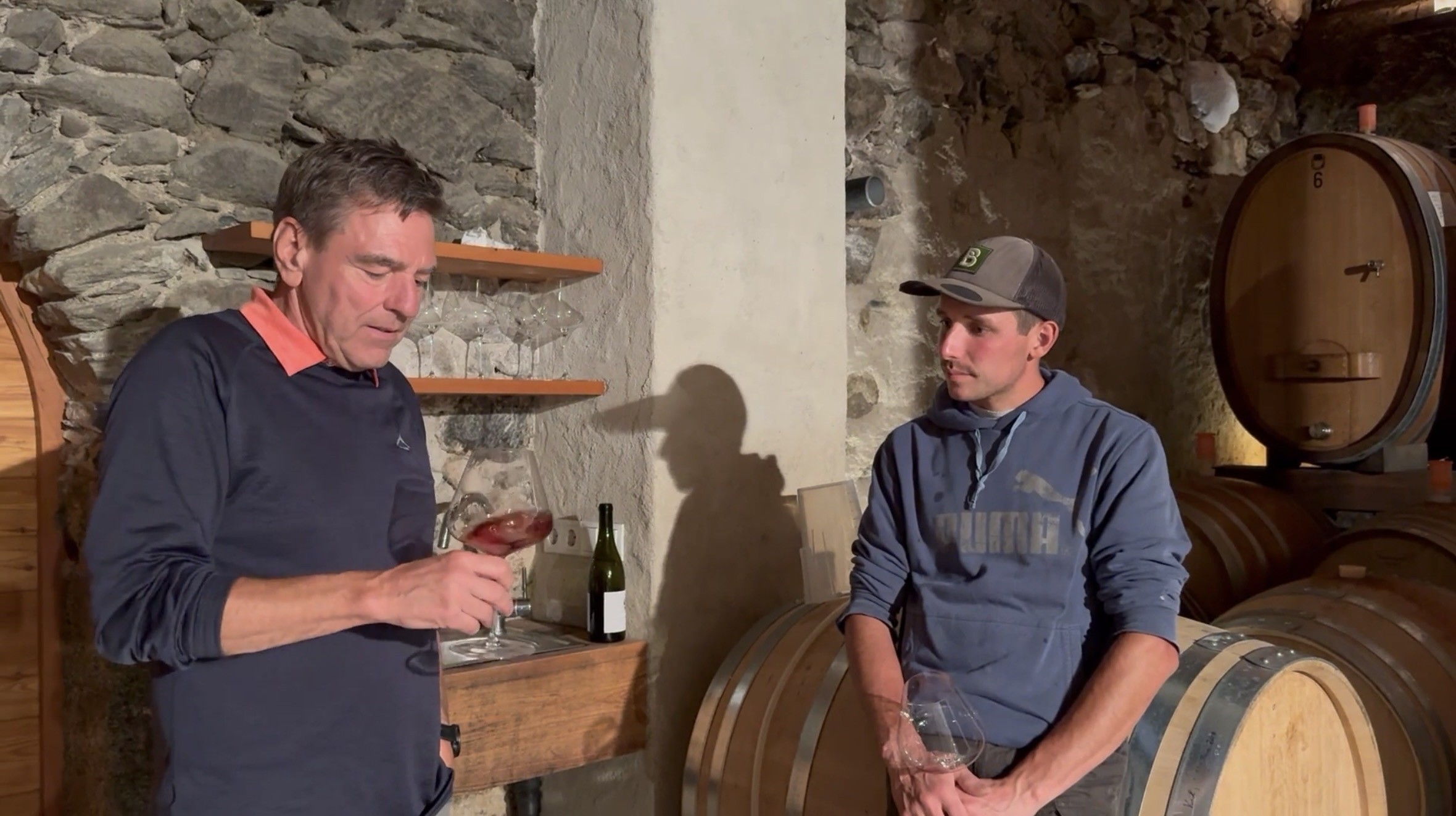
Jan tasting wine with Daniel Sigmund in his family’s cellar in Tschötsch, Alto Adige
Then came Daniel Sigmund, one of our favorite discoveries in northern Italy. His entire reply to Jan’s message was: “Hi Jan, Nice to hear from you! What time are you in our area today?” When we arrived in Tschötsch above Bressanone, Daniel was still working high in the vineyard. His grandfather was dozing peacefully on the porch. A quick phone call, and Daniel came walking down the mountain in vineyard boots with a broad smile.
Daniel is the first in his family to bottle wine under his own name, after generations of growing grapes for the local cooperative. His vineyards sit between 620 and more than 800 meters, on steep terraces where almost everything must be done by hand. In the cellar, he poured us a Silvaner that had been open for two weeks. We expected it to be tired. Instead, it was vibrant and full of life. Then he poured one that had been open for a month, and it was still astonishingly fresh. That visit taught us that freshness is not just a tasting note. It is the result of careful decisions from vineyard to cellar.
Where should you start? A quick reference
If you love familiar, food-friendly reds: Begin with Tuscany. Chianti Classico and Vino Nobile di Montepulciano are some of the best places to learn Sangiovese, especially with producers like Rocca delle Macìe, Crociani, De’ Ricci, Carpineta Fontalpino, Vallone di Cecione, and Tenuta degli Dei.
If you want something rich, slow, and powerful: Start in Valpolicella with Amarone. Campagnola, Masi, Monte Dall’Ora, and Monte dei Ragni each show a different side of the region, from cellar-worthy classics to small, soulful wines that are difficult to find.
If you are ready for structure and depth: Go to Piedmont. Nebbiolo from Barolo and Barbaresco may require more attention, but producers like Attilio Ghisolfi and Giuseppe Cortese make the learning deeply rewarding.
If you want energy and surprise: Choose Sicily and Mount Etna. Terre Nere and Al-Cantàra show why Etna is now one of Italy’s most exciting regions for single-vineyard, terroir-driven wines. Gambino adds the hospitality of the mountain, and Pupillo reminds us that Sicily’s wine story also includes the coast, Moscato di Siracusa, and sea-breeze freshness.
If you love vibrant white wines: Do not overlook Alto Adige. Abbazia di Novacella and Daniel Sigmund, including his intriguing Pinot Noir, showed us how mountain vineyards can produce wines with freshness, precision, and a kind of quiet confidence that lingers.
What we’d pour first
Rocca delle Macìe Chianti Classico Riserva, one of our trusted Tuscany bottles and a friendly, flavorful place to begin understanding Chianti Classico.
Campagnola Amarone della Valpolicella, one of our Amarone of choice wines for more than a decade, with vintages from 2012 through 2020 still resting in our cellar.
Masi Costasera Amarone, a classic that connects Valpolicella tradition, the Boscaini family’s vision, and the historic Serego Alighieri estate.
Tenuta delle Terre Nere Etna Rosso, the place to start if you want to understand why Mount Etna has become one of Italy’s most compelling volcanic wine regions. [Add affiliate link]. If you like this, you will LOVE, the Terre Nere Etna Rosso Gardiolo, and be haunted for the rest of your life, like we were.
Abbazia di Novacella Sylvaner, a beautiful introduction to Alto Adige’s alpine freshness, purity, and mineral character.
FAQ: Italian wine regions
What are the most important wine regions in Italy for beginners?
Start with Tuscany, Piedmont, Valpolicella, Sicily (especially Mount Etna), and Alto Adige. These regions give you a strong foundation in Sangiovese, Nebbiolo, Amarone, volcanic wines with site-specific character, and alpine white wines.
What Italian wine region should I try first?
Tuscany is usually the easiest first step because Chianti Classico and Vino Nobile di Montepulciano are flavorful, food-friendly, and widely available. If you already enjoy bold reds, Valpolicella and Amarone may be the better place to begin. The real answer: start with the region that matches the wines you already love.
Why is Mount Etna sometimes called the Burgundy of Italy?
Mount Etna is sometimes compared to Burgundy because its volcanic vineyard sites vary dramatically from one slope or contrada to another, allowing producers to make wines that express very specific places with clarity and precision. Nerello Mascalese, Etna’s leading red grape, can show the kind of elegance, minerality, and transparency that Pinot Noir lovers often associate with Burgundy, not because it tastes like Pinot, but because it shows place as clearly as Burgundy does.
What is the difference between Barolo and Barbaresco?
Both Barolo and Barbaresco are made from Nebbiolo in Piedmont, but they often express the grape differently. Barolo is typically more structured and powerful, with dense tannins and a longer aging potential. Barbaresco can feel more elegant and lifted, though both can be complex, age-worthy, and deeply expressive. Think of Barolo as the stronger-willed sibling.
Why is Amarone so different from other Italian red wines?
Amarone is made from grapes that are dried after harvest through a process called appassimento, concentrating flavor, sugar, and texture before fermentation. The result is a wine that can be rich, layered, and long-lived, especially when producers balance power with freshness and careful winemaking. It’s why Amarone rewards patience: both in the cellar and in the glass.
Is Italy better known for red wine or white wine?
Italy is famous for both, but many people begin with its reds: Chianti Classico, Barolo, Barbaresco, Amarone, and Etna Rosso. White wine lovers should explore Alto Adige, Etna Bianco, Soave, Verdicchio, and Friuli, where freshness and regional character can be remarkable. The beauty of Italy is that it does both exceptionally well.
How do I know which Italian wine to buy if I’m not familiar with the regions?
Start by matching the wine to the moment: What kind of meal are you cooking? How much time do you have? Are you looking for something to enjoy now or something to age? Then use the Where to Start section above to choose a region that fits. Finally, look for the producer names we’ve mentioned: Rocca delle Macìe, Fattoria Carpineta Fontalpino, Crociani, De’ Ricci, Campagnola, Masi, Ghisolfi, Cortese, Terre Nere, Al-Cantara, etc. These are producers we’ve spent time with and trust completely.
The real way to understand Italian wine
Italian wine becomes much easier to understand when you stop trying to memorize everything and begin with people, places, and stories. That is what we look for at Spoken Wines: the family table, the vineyard path, the cellar conversation, and the bottle that helps the story stay with you.
For more stories from the vineyards we visit around the world, subscribe to the Spoken Wines newsletter. We will bring you the people, places, and culture behind the wines worth remembering.
Visit our Italy page for a full overview of wine in Italy.
More from this country

Italy
Why Daniel Sigmund’s Alto Adige Mountain Wines Taste So Fresh
A first-generation winemaker turns the steep vineyards of the Eisack Valley into Silvaner, Riesling, and Pinot Noir defined by freshness, elegance, and place.

Italy
900 Years Later, This Winery Is Still Making Some of Italy's Most Remarkable White Wines
How Abbazia di Novacella has balanced centuries of tradition with wines that still feel vibrant, fresh, and unmistakably Alpine.

Italy
The Wines You’ll Never Forget — If You Can Find Them
A journey to Monte dei Ragni, one of the most soulful and elusive producers in Valpolicella.



From Vineyard to Inbox
Subscribe to our newsletter