How Tenuta Degli Dei Became Tommaso Cavalli’s Tuscan Wine Legacy
At Roberto Cavalli’s estate in Panzano, Tommaso Cavalli has spent more than 30 years turning a family passion for wine, horses, art, and beauty into something distinctly his own.
Tammy de Weerd - Spoken Wines

This will hide itself!
Tenuta Degli Dei is what happens when the Cavalli instinct for beauty leaves the runway and takes root in the Tuscan countryside.
Roberto Cavalli purchased the property in Panzano in Chianti in the early 1970s. His son Tommaso has since devoted more than 30 years to the estate, producing both Chianti Classico and Tuscan IGT wines while continuing the family’s original connection to horse breeding.
But we came to Tenuta Degli Dei because of our friend Mara.
“You need to meet Tommaso,” she told us. “This place, these wines, you’ll love it.”
That was all it took. That, and the fact that Mara works with Tommaso Cavalli, son of the late Roberto Cavalli: fashion icon, vintner, and visionary.
Roberto is no longer here, but his legacy remains visible across these Tuscan hills. Tommaso has not simply preserved that legacy. He has given it his own direction through the vineyards, the wines, and a life connected to the land he loves.
A name born from loyalty
Even the name Tenuta Degli Dei carries a personal story.
When Roberto Cavalli lived at the estate, his constant companion was a German Shepherd whose registered name was Didone degli Dei. Roberto affectionately called him Lupo.
Lupo was his shadow. To keep his companion’s memory alive, Roberto named the property Tenuta Degli Dei. The horses born through the estate’s breeding program could then carry the Degli Dei name too.
Long before the wines reached international tables, the estate’s identity was rooted in loyalty, memory, and the animals that shared Roberto’s life in Tuscany.
That history still matters today. Tenuta Degli Dei continues to bring wine and horse breeding together, two traditions Tommaso sees as closely connected to the land and culture of Tuscany.
Elegance off the beaten path
We arrived during the annual Vino al Vino in Cantina spring release weekend in Panzano in Chianti, a celebration that brings together some of the district’s leading wineries.
The town and surrounding countryside were alive with energy. Wineries opened their gates and poured their newest vintages amid the splendor of the Tuscan vineyards.
Tenuta Degli Dei was no exception, but its event felt different. It was intimate, carefully considered, and distinctly Cavalli.
Tucked into the hills of San Leolino, the narrow drive winds past ancient stone walls and the Romanesque church that guards the Cavalli wine cellars. The Pieve of San Leolino was first mentioned in 982 AD, and the winery’s cellars now occupy part of this historic setting.
The view opens as you arrive. At first, everything feels quiet. Then you turn the corner.
Music is playing. Wine is being poured. The smell of fresh food draws you toward the tasting area. Vineyards roll toward the forest, while stone, art, wine, and landscape come together around you.
This is more than a Tuscany wine experience. It is a fusion of art, beautiful landscapes, and fine wine.

A woman pours Tenuta Degli Dei red wine for a guest at an outdoor tasting surrounded by green Tuscan hills.
Meeting Tommaso, the man behind the wine
Nadia welcomed us with glasses in hand. Mara introduced us to Tommaso.
He had a quiet presence and thoughtful eyes, standing among the bottles, art, and weight of his own family legacy. He welcomed us with an understated charm that made the moment feel personal.
Tommaso signed a bottle for us with care. It was his flagship 2020 Cavalli, a Tuscan red. The day around him was clearly full, but he never made the moment feel rushed.
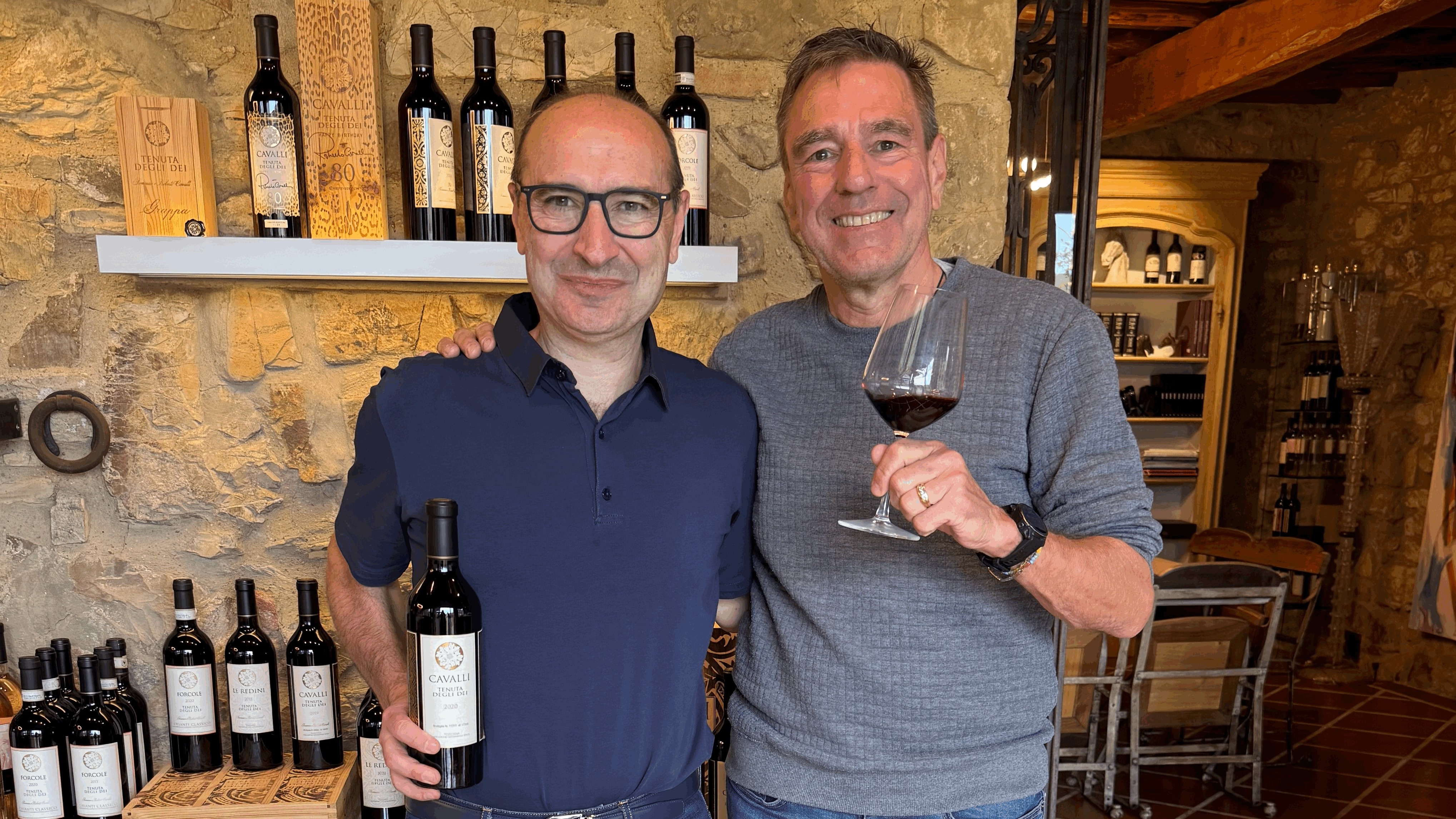
Two men stand together in the stone tasting room, one holding a bottle of 2020 Cavalli and the other holding a glass of red wine.
That gesture stayed with us because it reflected the estate itself. Tenuta Degli Dei may carry one of Italy’s most recognizable names, but our experience was not loud or theatrical. It felt considered and personal.
The vineyards stretched across the rolling hills and merged with the forest line. The wines felt deep and deliberate. They echoed this place through both Chianti Classico and Tuscan reds.
The estate still breeds horses. It still bears the imprint of the Cavalli name. But here, fashion has traded silk for Sangiovese, Cabernet Sauvignon, Cabernet Franc, Petit Verdot, Merlot, and Alicante.
Tommaso has chosen to make his own mark in the vineyard. Whether tasting a bold Cabernet-based wine or a finely tuned Tuscan blend, you experience more than technique. You experience a journey from Roberto’s vision to Tommaso’s life on the land.
The wines of Tenuta Degli Dei
Tenuta Degli Dei produces wine in two distinct directions.
Forcole is the estate’s Chianti Classico DOCG. Made entirely from Sangiovese grown in Panzano, it represents the Tuscan tradition surrounding the estate. The winery describes it as fresh, lively, and expressive of the marl-rich soils of Panzano.
Le Redini is a Tuscan IGT wine made primarily from Merlot, with Alicante completing the blend. It offers a younger and more fruit-driven introduction to the estate while retaining the structure associated with the hills of Panzano.
At the top of the portfolio is Cavalli, the flagship Tuscan IGT wine Tommaso poured during our visit. The current blend combines Cabernet Sauvignon, Petit Verdot, and Cabernet Franc from organically farmed vineyards in Panzano. It is matured for 18 months in barrels and tonneaux, giving the wine the structure and intensity that defined our experience of it.
Tommaso works alongside enologist Carlo Ferrini and agronomist Gioia Cresti. We also met Gioia at Carpineta Fontalpino, where she showed us how contrasting Tuscan vineyards can give wine entirely different personalities.
That combination of Tommaso’s vision, Gioia’s knowledge of the land, and Carlo’s enological experience helps explain why the wines feel polished without losing their connection to place.
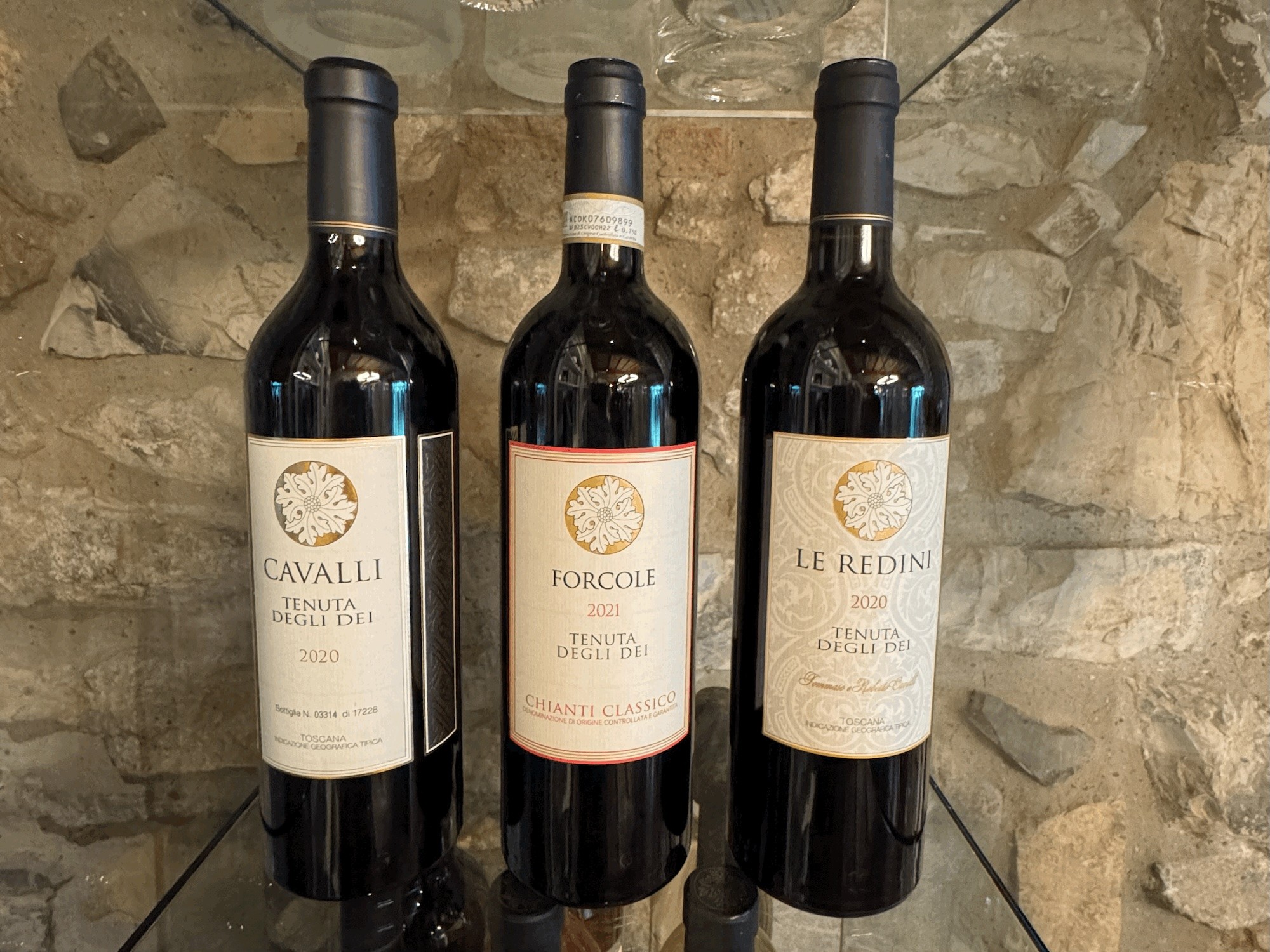
Bottles of 2020 Cavalli, 2021 Forcole, and 2020 Le Redini displayed against a stone wall at Tenuta Degli Dei.
What to taste first
Begin with Forcole if you want to understand the traditional side of Panzano in Chianti. Its pure Sangiovese expression connects the estate directly to Chianti Classico.
Choose Le Redini if you enjoy Merlot and want a softer, more fruit-driven entry into the Tenuta Degli Dei portfolio.
Then taste Cavalli to experience the estate’s most structured and ambitious red. This was the wine Tommaso signed for us during the spring release weekend. It became more than a treasured Italian red. It became a memory we could carry home.
To find the exact wine connected to our visit, look for the 2020 Tenuta Degli Dei Cavalli. This is the flagship Tuscan red that Tommaso signed for us during the spring release weekend. JJ Buckley currently lists the 2020 vintage in stock with an active add-to-cart option.
Availability and shipping eligibility can change, so confirm both before ordering.
The wines are elegant, well structured, and intense.
Have you ever seen a wine walk the runway? That is how we experienced them. They had polish and presence, but the real substance came from the vineyards and the work behind them.
Planning a visit to Tenuta Degli Dei
A visit to Tenuta Degli Dei brings together several sides of the estate: the Romanesque church, the fermentation room, the vaulted barrel cellar, the vineyards, the wines, and the horses.
The official experience includes a guided visit to the Pieve of San Leolino, the winery, and the vineyards, followed by a tasting. Guests may also have the opportunity to visit the estate’s stables.
The winery currently lists visits by appointment from Monday through Saturday, with scheduled times at 11:00 a.m. and 3:00 p.m. The full experience lasts approximately two hours and can be offered in Italian, English, French, or German.
Because schedules and availability can change, check the winery’s current visitor information before planning your trip.
The meeting point is in front of the church at San Leolino in Panzano. It is a fitting place to begin because the experience is not only about tasting wine. It is about seeing how history, architecture, vineyards, horses, and one family’s idea of beauty come together.
A taste of Tuscany, styled by Cavalli
As we left and said goodbye to Mara, we understood why she had insisted that we come.
We got the wine, but we also got a memory to take home.
Our visit was more than a stop on a wine tour. It was the chance to experience one chapter in a continuing legacy. One part Roberto. One part Tommaso. One part Tuscany itself.
The name Cavalli may first evoke fashion, color, glamour, and the runway. At Tenuta Degli Dei, it means something quieter. It means vineyards meeting the forest, horses in the Tuscan hills, wine maturing beneath a Romanesque church, and a son devoting decades to the land his father chose.
As Tommaso has said, “Winemaking is more a lifestyle, connected with the land that I love and where I live.”
Tenuta Degli Dei is part of the Tuscany chapter in our guide to the most important wine regions in Italy, alongside the producers who helped us understand Piedmont, Valpolicella, Sicily, Alto Adige, and the many different voices of Tuscany.
Visit our Italy page to continue exploring the regions, producers, and wines that make Italy easier to understand.
For firsthand reports from the vineyards and cellars we visit, subscribe to the Spoken Wines newsletter.
More from this country

Italy
The Most Important Wine Regions in Italy, and Where Should You Start?
A traveler's guide to the regions, producers, and stories that make Italian wine easier to understand

Italy
Why Daniel Sigmund’s Alto Adige Mountain Wines Taste So Fresh
A first-generation winemaker turns the steep vineyards of the Eisack Valley into Silvaner, Riesling, and Pinot Noir defined by freshness, elegance, and place.

Italy
900 Years Later, This Winery Is Still Making Some of Italy's Most Remarkable White Wines
How Abbazia di Novacella has balanced centuries of tradition with wines that still feel vibrant, fresh, and unmistakably Alpine.



From Vineyard to Inbox
Subscribe to our newsletter