From Film to Chianti Classico: Italo Zingarelli’s Legacy at Rocca delle Macìe
The Italian film producer who bought a forgotten Tuscan estate created a family wine story that still unfolds in the hills of Castellina in Chianti.
Tammy de Weerd - Spoken Wines

This will hide itself!
Driving through Chianti is almost overwhelming in the best possible way. Vineyards roll across the hills between olive groves, wooded slopes, and old stone hamlets.
I was leaning out of the car window, taking photographs as quickly as I could, when I captured one of the most beautiful views of the trip. A moment later, we realized we had arrived at Rocca delle Macìe.
We had been drinking and enjoying their wines for nearly a decade, so being invited to the estate for an interview felt like coming full circle.
The winery’s name translates roughly as “fortress of the stone heaps.” Standing among the Tuscan hills, it did feel like a place from a film.
That seemed fitting. Rocca delle Macìe began with an Italian film producer who decided to write a new kind of story.
Italo Zingarelli’s second act
In the early 1970s, Italo Zingarelli was known for producing popular Italian films, including Spaghetti Westerns. But he had another dream: to restore a neglected Tuscan estate and make wine.
In 1973, he purchased the Le Macìe estate near Castellina in Chianti. The property included a forgotten fourteenth-century hamlet and a small vineyard.
According to the family story, Italo first visited the property with his wife and two friends on a rainy Sunday afternoon. They expected to stay only a few minutes. His wife and friends did not even leave the car.
Italo returned with a purchase agreement.
The decision changed the direction of the family. He began restoring the hamlet, caring for the land, and developing the winery. The film producer had found a new subject: the landscape, people, and wines of Tuscany.
The official winery describes the estate as a vision that began with Italo and continues through the Zingarelli family today. Rocca delle Macìe now includes multiple estates across Tuscany, with the family still involved in vineyards, production, hospitality, and the future of the business.
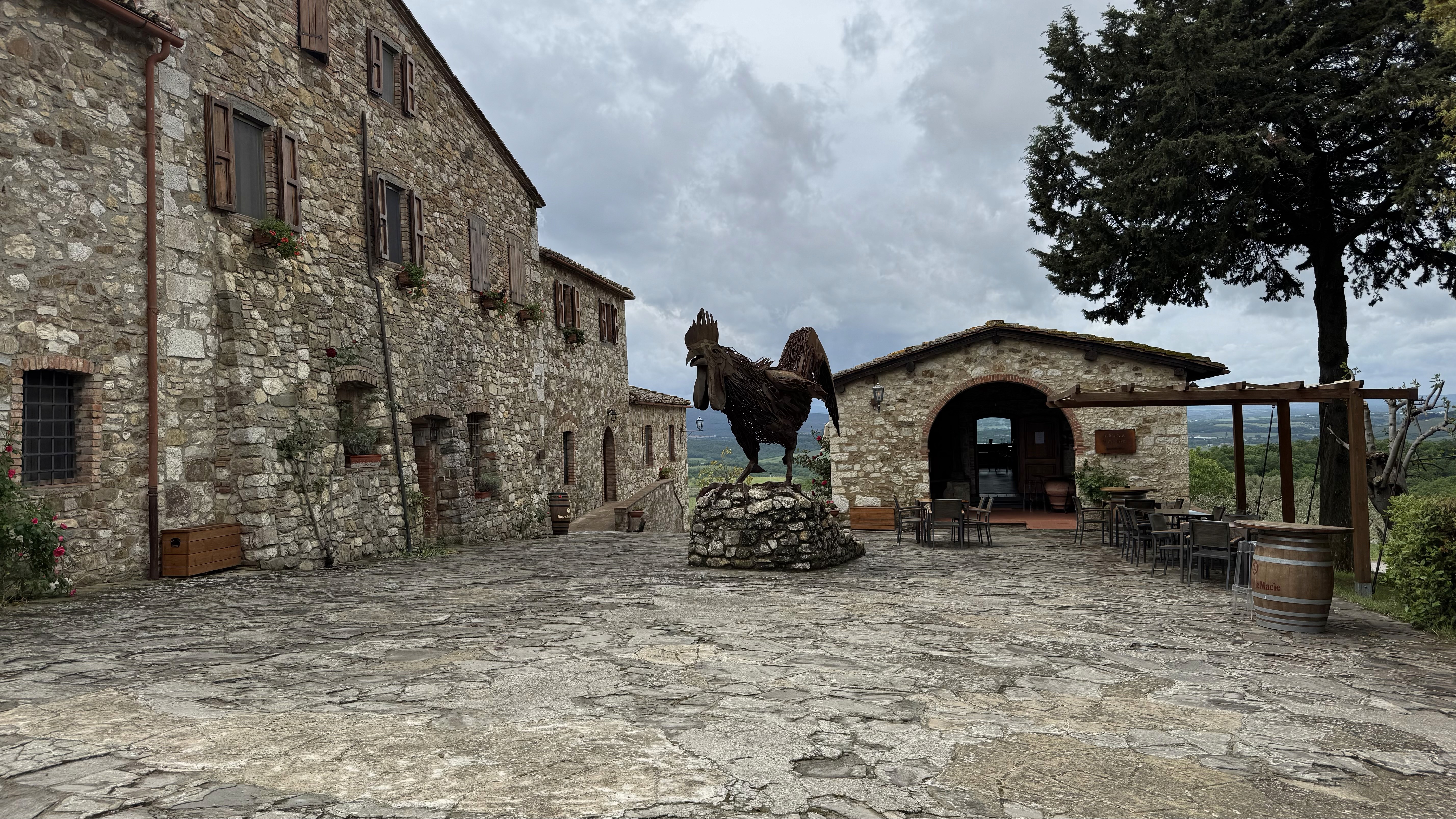
Rocca delle Macìe - “fortress of the stone heaps”
A family story, not just a family business
Italo’s son Sergio began working with his father in 1985. Together, they spent years refining the wines and expanding the estate. Today, Sergio, his wife Daniela, and their children, Giulia and Andrea, continue that work.
Giulia connects the winery with the hospitality experiences at Tenuta Fizzano, while Andrea works across the cellar, vineyards, and daily management of the estate alongside his father. Their responsibilities may be different, but the connection between them is clear. Rocca delle Macìe is not simply a winery owned by a family. It is a family shaping the winery together.
Sergio’s wines balance tradition with innovation while focusing on terroir and the distinct character of individual vineyards. That philosophy became especially clear when we tasted the estate’s Gran Selezione wines.
The family spirit extends beyond the Zingarellis. Our host, Georgeta, spoke about them with genuine affection, as if she were describing members of her own family. It was clear that the people working beside the family, and their well-being, mattered deeply.
We felt that same care as visitors. Over lunch at Sergio and Daniela’s family table, joined by members of the leadership team, we experienced the warmth that Georgeta had described. The meal was generous, personal, and unhurried. It was the kind of hospitality that makes you want to stay longer because you feel included in the family’s story.
The Zingarelli family is deeply connected with those who work alongside them
The Chianti Classico Riserva that brought us there
We had been drinking Rocca delle Macìe’s Chianti Classico Riserva for nearly a decade, and we loved it. It had become one of our trusted bottles and easily belonged among our top five wines.
Visiting the estate helped us understand why.
During our visit, we learned that the Riserva brought together fruit from four family estates, each with different soils and exposures. That blending gave the wine a broader expression of Chianti Classico. It was earthy and vibrant, with leather and spice alongside cherry, plum, and fig.
We were also struck by the scale. At the time of our visit, we were told that Rocca delle Macìe produced approximately 300,000 bottles of the Riserva each year, within a total annual production of more than one million bottles. Maintaining that sense of depth and character at such volume made the wine even more impressive.
For someone facing a shelf of Chianti Classico, the Riserva remains a useful place to begin. It is the familiar bottle that first brought us to Rocca delle Macìe, and the visit gave us a deeper understanding of the land and family behind it.
The Riserva remained a wine we already loved. But tasting at the estate revealed another level of the family’s work.
Two Gran Selezione wines that changed the conversation
At Rocca delle Macìe, we also tasted two small-lot Gran Selezione wines.
Il Crocino, from the sandy soils of Tenuta Fizzano, was elegant and earthy, with long, fine tannins.
The Sergio Zingarelli, made from grapes grown on marl and loam-rich terraces below the winery, was fuller, darker, and silkier.
The difference between the wines was not simply a matter of quality. It was a demonstration of how vineyard site can change the expression of Sangiovese.
We could not choose between them, so we did what seemed most sensible: we took both.
The amazing single vineyard Gran Selezione expressions: Il Crocino and the Sergio Zingarelli
Why Rocca delle Macìe is worth visiting
Rocca delle Macìe is worth visiting because it brings several sides of Chianti Classico together in one place: a family history rooted in cinema, a trusted Riserva made at meaningful scale, single-vineyard Gran Selezione wines, and the warm hospitality we experienced around Sergio and Daniela’s table.
The winery is near Castellina in Chianti, approximately twenty minutes by car from Siena and one hour from Florence. Its current experiences range from introductory tastings to cellar tours, food and wine experiences, vertical tastings of the Chianti Classico Riserva, and focused tastings of the estate’s Gran Selezione wines.
Current schedules, prices, and availability vary by experience and season. Review Rocca delle Macìe’s current visits and tastings before making your plans.
What to taste first
If you are discovering Rocca delle Macìe at home, begin with the Chianti Classico Riserva. It is the bottle we had trusted for nearly a decade before our visit, with the earthy and vibrant character that first made us want to understand the estate.
Marketview Liquor currently lists the 2019 Rocca delle Macìe Chianti Classico Riserva in stock, with online ordering and shipping to more than 40 states.
Availability and shipping eligibility can change, so confirm both before ordering.
At the estate, move from the Riserva to the Gran Selezione wines. Il Crocino and Sergio Zingarelli showed us how dramatically vineyard site can change the expression of Sangiovese. One was elegant, earthy, and finely structured. The other was darker, fuller, and silkier. Together, they turned a familiar winery into a deeper discovery.
Rocca delle Macìe is one of the Tuscany stories included in our guide to the most important wine regions in Italy.
Sergio Zingarelli captured his father’s transformation from filmmaker to vintner in one unforgettable observation:
“My father said he was more excited to see his wine on a table in a New York restaurant than he was seeing a line of hundreds of people outside a theater in Milan to see one of his films.”
That may be the clearest description of Italo’s second act. His greatest story was not written for the cinema. It continues in the vineyards, cellars, wines, and family tables of Chianti Classico.
Continue exploring the country through our Italy wine guide.
More from this country

Italy
The Most Important Wine Regions in Italy, and Where Should You Start?
A traveler's guide to the regions, producers, and stories that make Italian wine easier to understand

Italy
Why Daniel Sigmund’s Alto Adige Mountain Wines Taste So Fresh
A first-generation winemaker turns the steep vineyards of the Eisack Valley into Silvaner, Riesling, and Pinot Noir defined by freshness, elegance, and place.

Italy
900 Years Later, This Winery Is Still Making Some of Italy's Most Remarkable White Wines
How Abbazia di Novacella has balanced centuries of tradition with wines that still feel vibrant, fresh, and unmistakably Alpine.



From Vineyard to Inbox
Subscribe to our newsletter