Why Crociani Vino Nobile di Montepulciano Is Family History in a Glass
Inside Susanna Crociani’s fourteenth-century cellar, every wine carries the memory of the father and brother who led her back to Montepulciano.
Jan and Tammy de Weerd - Spoken Wines
This will hide itself!
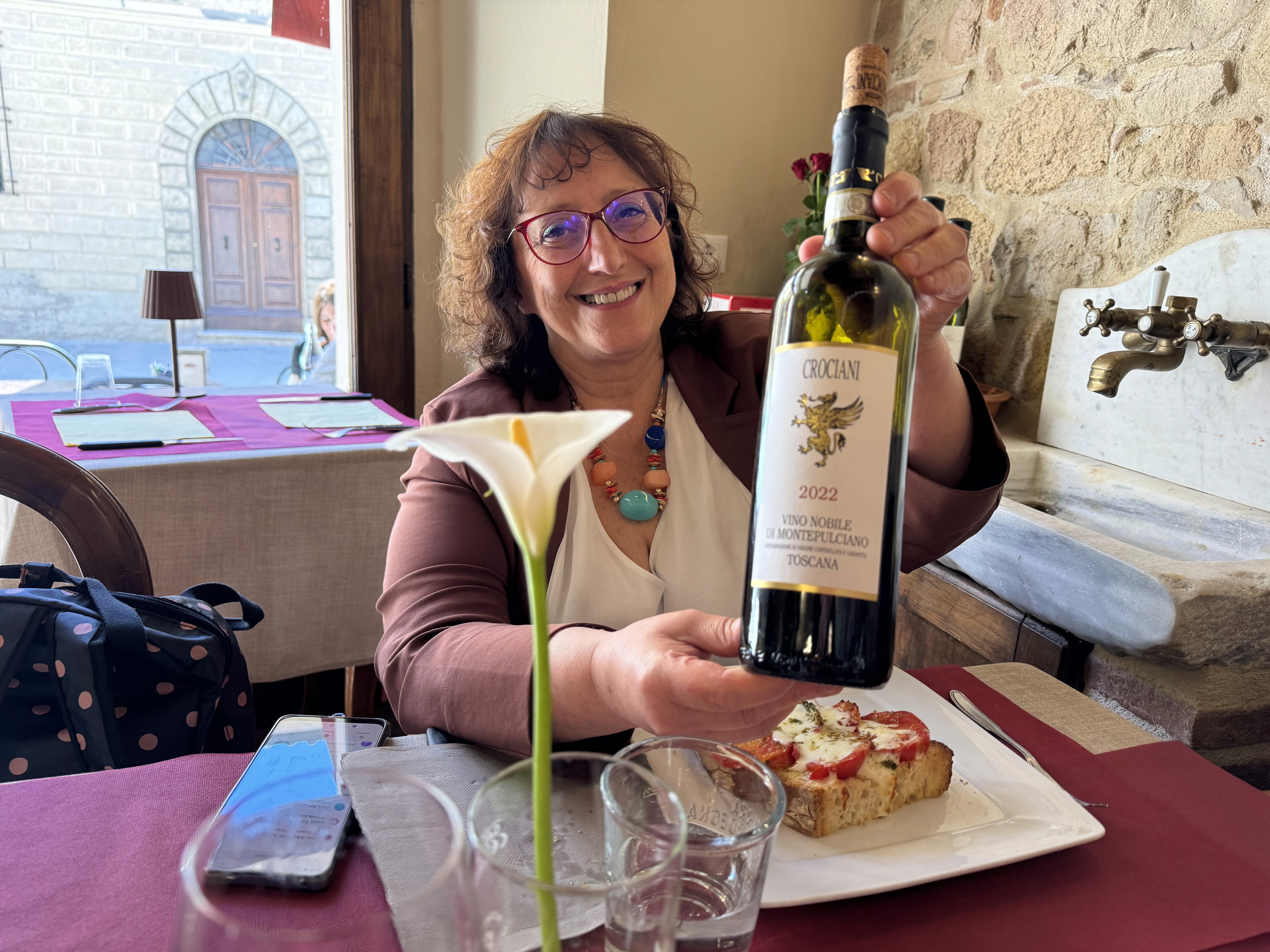
If you see Vino Nobile di Montepulciano on a wine list, here is the first thing to know: it is a Tuscan wine based primarily on Sangiovese, known locally as Prugnolo Gentile. It is not made from the Montepulciano grape associated with Abruzzo.
At Cantina Crociani, Susanna Crociani gave us an even more memorable way to understand it.
“Vino Nobile is like a gentleman,” she explained. Elegant, present, and persistent. A noble wine from a noble land.
That description captures what drew us to Crociani years before we visited the winery. Its Vino Nobile carries the structure you expect from an important Tuscan red, but it also has warmth and personality. Once we met Susanna inside her family’s fourteenth-century cellar in Montepulciano, we understood why. For her, wine is not simply a product of grapes and aging. It is how she keeps the people she loves present.
The promise Susanna was never meant to keep
Susanna did not grow up dreaming of becoming a winemaker. She resisted the idea completely.
She was independent, passionate about music and history, and determined to build a life outside the family winery. Her father, Arnaldo, had dedicated himself to making wine, while her brother Giorgio worked beside him and helped bring the wines into the world.
When Arnaldo died in 1999, Susanna’s direction changed.
“It was my destiny,” she told us.
It took 18 months for her to unwind her previous life and return fully to Montepulciano. She came back to help Giorgio with the winery, stepping into the family story she once believed she could leave behind.
The official Crociani history describes the change simply: the winery’s story became Susanna’s story. But standing with her in the cellar, we could feel how much that decision carried. She was not merely taking control of a business. She was returning to her father, her brother, and the place that had quietly shaped her all along.
A medieval cellar filled with memory
Crociani’s wines are made in a newer production cellar, but they mature in large Slavonian oak barrels inside the family’s fourteenth-century cellar in Montepulciano’s historic center.
The cellar is more than a beautiful place to age wine. For Susanna, it is where her father’s teachings still echo and where her brother’s presence remains. Beneath the cellar lie Etruscan caves dating to 400 BC, adding another layer of history to the space where Crociani’s wines mature.
She keeps a bottle of 1964 Vin Santo that her father gave her on her tenth birthday. Written by hand on the bottle are the words, “Unico esemplare per Susi,” meaning it was the only example made for her.
She has never opened it.
It is not because there have been no special moments. The bottle itself has become the special moment, holding the memory of her father in a form she is not ready to release.
That same desire to preserve memory appears throughout the Crociani portfolio.
The wines that carry Arnaldo and Giorgio forward
Rosso d’Arnaldo IGT was created by Susanna’s father, Arnaldo, from the knowledge he developed over a lifetime in the cellar. The wine is aged for 18 months in wooden barrels and bears his name.
Il Segreto di Giorgio IGT honors her brother. The wine takes its name from a secret parcel of Sangiovese Grosso that Giorgio kept for himself, the source of the fruit behind the bottle. The winery describes it as a wine for loyal friends, sincere conversations, and well-kept secrets. It reflects the qualities Susanna saw in Giorgio: simplicity, spontaneity, goodness, and purity.
The numbered bottles carry a rainbow on the label. Susanna explained its meaning to us: “The rainbow never ends, and you can never reach the end of it.”
These wines are personal, but Crociani’s defining expression remains its Vino Nobile di Montepulciano DOCG.
Crociani makes it from 80 percent Prugnolo Gentile, 10 percent Canaiolo Nero, and 10 percent Mammolo. It matures for two years in oak and rests for at least two additional months in bottle before release. The result is floral, harmonious, and gently tannic, with the presence and persistence Susanna compared to a gentleman.
These were the Crociani wines we had admired for years. Tasting them in the cellar showed us that their character is inseparable from the family behind them.
What to taste first
Begin with Crociani Vino Nobile di Montepulciano if you want to understand the estate and the region. It introduces Prugnolo Gentile through a wine that balances structure with elegance.
If you want the most intimate part of the family story, seek out Il Segreto di Giorgio or Rosso d’Arnaldo. One remembers Susanna’s brother. The other carries forward her father’s work.
Crociani also produces Rosso di Montepulciano, Chianti Colli Senesi, Vin Santo di Montepulciano, and several younger wines. But the Vino Nobile remains the clearest meeting point between family memory and the character of Montepulciano.
Explore Crociani’s current wines and contact the winery about availability.
A hands-on winery in the heart of Montepulciano
Cantina Crociani remains an intimate operation. Susanna works with a small team and approaches each vintage with the belief that the wine must be allowed to reveal its own direction. Roberta has worked alongside Susanna for 24 years, and Luca leads guests through tastings in the cellar.
“The wine will tell you where it wants to go,” she told us.
During our visit, she also spoke about organic farming and the two hectares of land she had devoted to trees, flowers, and biodiversity. These choices reflected the same principle we found throughout the winery: what Susanna inherited should not simply be preserved. It should be cared for and passed forward with intention.
Susanna’s influence reaches beyond her own cellar. She currently serves her third consecutive term as vice president of the Consorzio del Vino Nobile di Montepulciano, working alongside president Andrea Rossi to represent the appellation’s producers. Susanna is the only woman among the consortium’s president and two vice presidents. During our visit, Susanna told us that nearly 40 percent of producers in the region were women, many of whom had stepped in when their fathers could no longer carry the torch.
Visitors can find Cantina Crociani at Via del Poliziano 15 in Montepulciano’s historic center. The winery organizes visits and tastings in its medieval cellar. Contact the winery through its official contact page to confirm current availability before visiting.
For another perspective on wine beneath Montepulciano’s historic streets, explore our visit to De’ Ricci Cantine Storiche. Together, the two cellars reveal how the town’s architecture, wine, and family histories remain connected.
Wine as an expression of love
We arrived at Crociani because we had fallen in love with its Vino Nobile di Montepulciano. We left carrying something deeper.
Susanna’s story helped us understand that legacy is not simply inheriting what came before. It is choosing what to carry forward, even when that choice was never part of the life you imagined.
“For me, wine in the glass is my expression of love,” she told us. “Love for what I do, love for my family, my brother, my father.”
That is what gives Crociani Vino Nobile its emotional weight. It is not only a Tuscan red with elegance and persistence. It is family history, returned to the glass.
Cantina Crociani belongs to the Tuscany chapter of our guide to the most important wine regions in Italy.
Visit our Italy page to continue exploring the people, places, and wines that make each Italian region distinct.
For firsthand reports from the vineyards and cellars we visit, subscribe to the Spoken Wines newsletter.
More from this country

Italy
The Most Important Wine Regions in Italy, and Where Should You Start?
A traveler's guide to the regions, producers, and stories that make Italian wine easier to understand

Italy
Why Daniel Sigmund’s Alto Adige Mountain Wines Taste So Fresh
A first-generation winemaker turns the steep vineyards of the Eisack Valley into Silvaner, Riesling, and Pinot Noir defined by freshness, elegance, and place.

Italy
900 Years Later, This Winery Is Still Making Some of Italy's Most Remarkable White Wines
How Abbazia di Novacella has balanced centuries of tradition with wines that still feel vibrant, fresh, and unmistakably Alpine.



From Vineyard to Inbox
Subscribe to our newsletter