Why Giuseppe Cortese’s Rabajà Barbaresco Takes You on a Journey
At Giuseppe Cortese in Barbaresco, one family’s devotion to the Rabajà vineyard reveals how Nebbiolo can be graceful, gripping, and deeply rooted in place.
Jan de Weerd - Spoken Wines
This will hide itself!
Giuseppe Cortese’s Rabajà Barbaresco matters because it reveals what Nebbiolo can become when one family spends generations listening to a single vineyard. The wine begins with the fragrance and grace many people associate with Barbaresco, but then its tannins take hold, carrying you through layers of strength, depth, and persistence.
We tasted that journey at its source, in Rabajà, one of Barbaresco’s most revered crus.
There is a modest house nestled among the vines. It is not a guesthouse or a cellar door. It is where Giuseppe Cortese was born, where he grew up, and where he slept among the rows that would one day help make Barbaresco known around the world.
You can also see the Cortese family and the Rabajà vineyard in our short film, A Quiet Revolution in Barbaresco: The Cortese Family Story.
The courage to bottle a vineyard’s identity
At a time when his family was simply farming the land, Giuseppe had a different vision. He wanted to share what he tasted in the vineyard and what he felt growing up in Rabajà.
So he began making wine.
Quietly and carefully, he expanded his family’s holdings in this historic vineyard and began bottling wines that spoke honestly of the place he called home. In 1971, when few people recognized Barbaresco’s potential, Giuseppe chose to believe in it.
Today, his children, Tiziana and Pier Carlo, carry that vision forward. Their wines, like their father’s, are not crafted simply to impress. They are meant to express.
The wines the Cortese family produces from Rabajà reflect the vineyard’s character: structured but agile, elegant yet grounded, with layers of depth. This matters when you are choosing a Barbaresco because the label does not merely name a region. It identifies a particular vineyard interpreted by a family that has known it across generations.
Carried forward, close to the ground
We arrived on a clear May morning, the sun finally breaking through after days of rain.
Gabriele, Tiziana’s husband and head of sales, welcomed us with humor and warmth, thanking us for bringing the sun along.
It is a true family operation. Everyone is involved, and everyone remains close to the ground.
From the vineyard deck, Tiziana shared memories of her father. In the cellar, Pier Carlo explained his winemaking philosophy. Together, they showed us a vision built upon Giuseppe’s quiet courage to start his own winery and make wine from the vineyard in which he was born.
Now the family is inviting the world to experience it.
Their story offers a different perspective on Piedmont from our unexpected visit with the Ghisolfi family in Barolo. Both families work with Nebbiolo, but their stories and vineyards reveal how profoundly place can shape the grape.
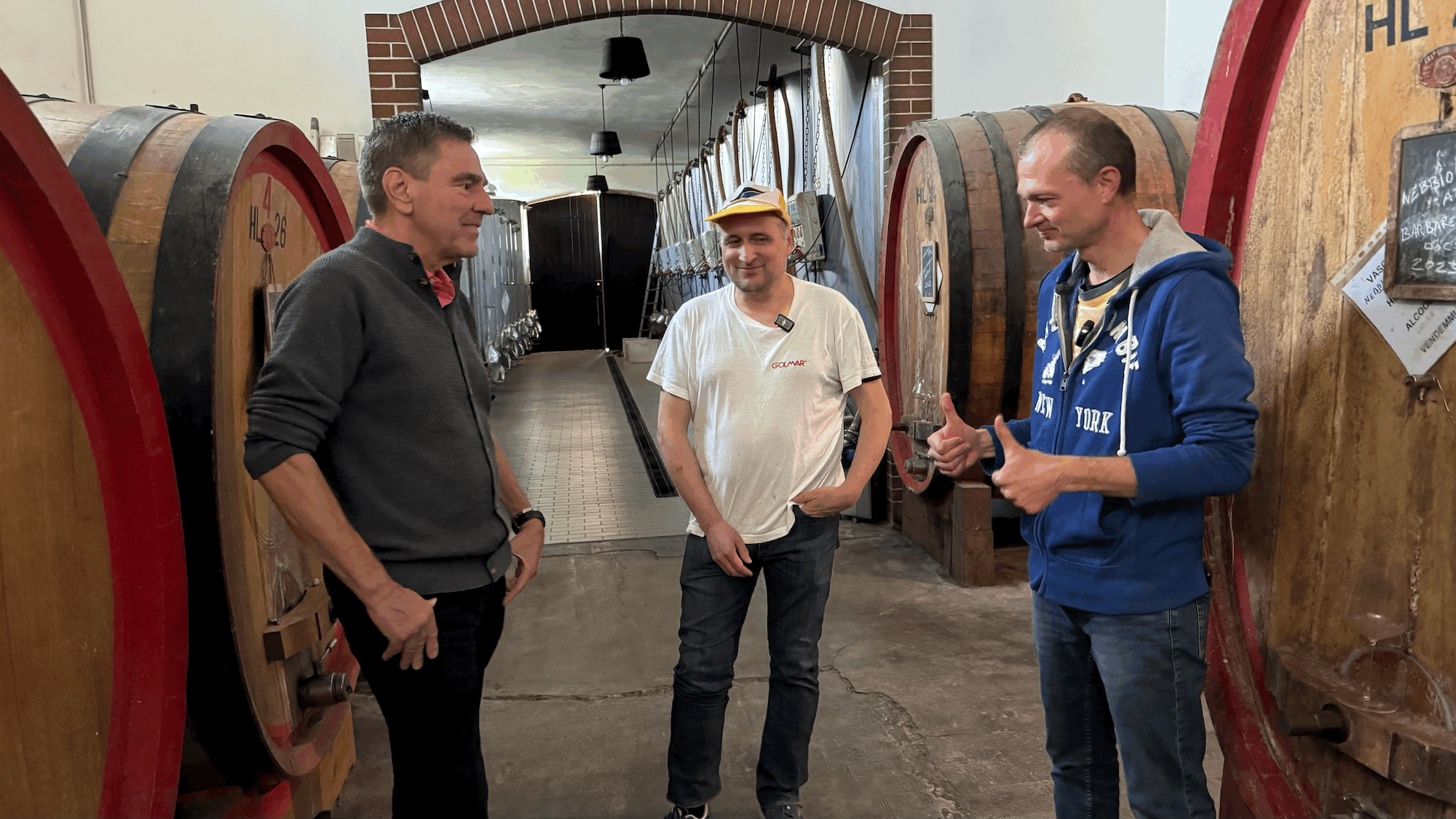
Pier Carlo and Gabriele share the Cortese family’s vision inside the cellar, a vision built on Giuseppe’s quiet courage.
The boy in the vineyard
Giuseppe Cortese lived what most winemakers can only dream about.
His house still sits in the middle of Rabajà, looking over vines shaped by sun, slope, and the cool breath of the Tanaro River valley. From that vantage point, Tiziana walked us through her father’s beginnings.
At the time, Barbaresco was often seen as Barolo’s quieter sibling, not yet elevated on the world stage.
Giuseppe recognized the power of the terroir early. He sensed something noble in the soil and set out to make wines that captured its grace. Slowly, he acquired more parcels within Rabajà. Over time, a small patchwork of vines became a vineyard legacy.
As the family told us, “Fifty years ago, Barbaresco was the poorer brother of Barolo. Today, we are as two twins.”
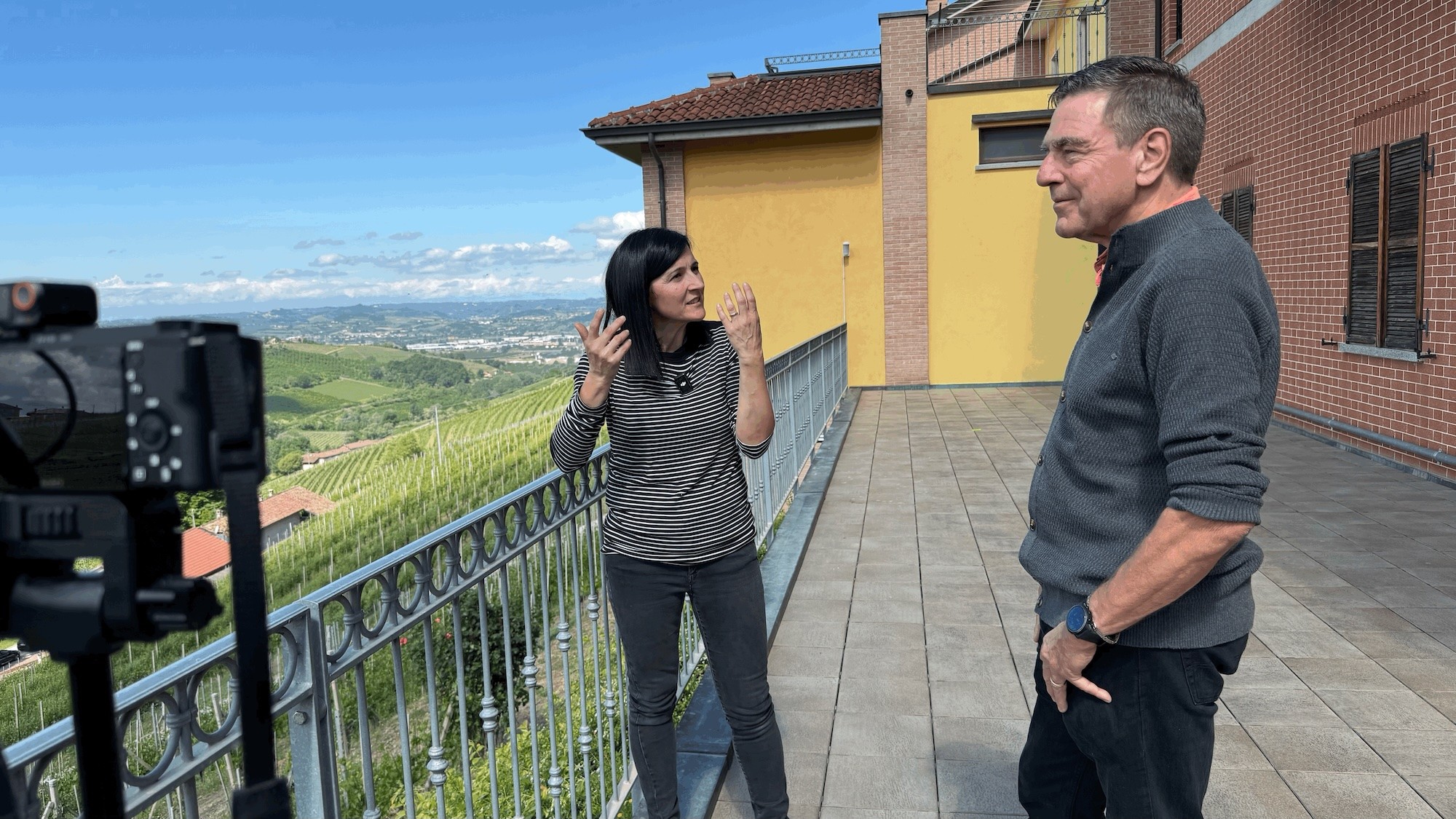
From the vineyard deck, Tiziana shared the story of her father growing up in the little house among the Rabajà vines.
Barolo and Barbaresco are both made from Nebbiolo, but experiencing them through families such as Ghisolfi and Cortese makes the distinction more than an abstract comparison. Each place gives Nebbiolo its own balance of perfume, tannin, energy, and depth.
Wines that do not wear makeup
In the cellar, Giuseppe’s son Pier Carlo continues the family approach: minimal intervention and maximum expression.
The wines are made traditionally, with native yeast fermentations and careful aging choices. The Barbaresco wines are fermented in stainless steel and old cement tanks, then matured in large Slavonian oak barrels. The family also uses clay amphora, stainless steel, and French oak for different portions of its Scapulin Chardonnay.
The methods vary according to the wine, but the purpose remains the same: allow each grape and vineyard to retain its own voice.
There are no tricks here. Only care.
Even the Dolcetto and Chardonnay receive the same attention as the Barbaresco.
The Dolcetto surprised us. It was lean, dry, and vibrant, with nothing sweet about it despite what the name might imply.
The Chardonnay, called Bianco Scapulin, felt more alpine than oaky. We tasted lemon and gooseberry, giving it the freshness and energy of a Piedmontese interpretation of Grüner Veltliner. The winery matures different portions of this Chardonnay in stainless steel, clay amphora, and small French oak barrels, bringing freshness, mineral character, and body into balance.
But it was in the Rabajà Barbaresco that Giuseppe’s full vision came to life.
What Rabajà Barbaresco tastes like
Drinking the Rabajà Barbaresco felt like stepping into a rose garden and then riding out on a horse with a leather saddle.
It was elegant and layered, but strong-willed at heart.
The wine is made entirely from Nebbiolo grown in approximately four hectares of the Rabajà vineyard. The vines sit on limestone and clay soils rich in minerals, with south and southwest exposures. After fermentation, the wine ages for approximately 20 to 22 months in large Slavonian oak barrels, followed by at least ten months in bottle before release.
Those details help explain the wine’s structure, but they do not fully capture the experience of drinking it.
The Cortese family’s Nebbiolo reminded us of riding a roller coaster. The entry is easy, and then the wine gets hold of you. It grabs you and takes you on a journey.
The Rabajà Barbaresco carries you to the highest levels, the deepest valleys, and the longest finish. Its floral character draws you in, but its tannin and structure keep the experience moving long after the first impression.
For someone beginning to explore Piedmont, this is why Nebbiolo can be so compelling. It does not give everything away immediately. It asks for your attention and then rewards it.
The wine at the center of this story is Giuseppe Cortese Rabajà Barbaresco. The 2022 vintage has its own exact Wine.com listing, giving readers a direct path to the producer, vineyard, wine, and vintage discussed here.
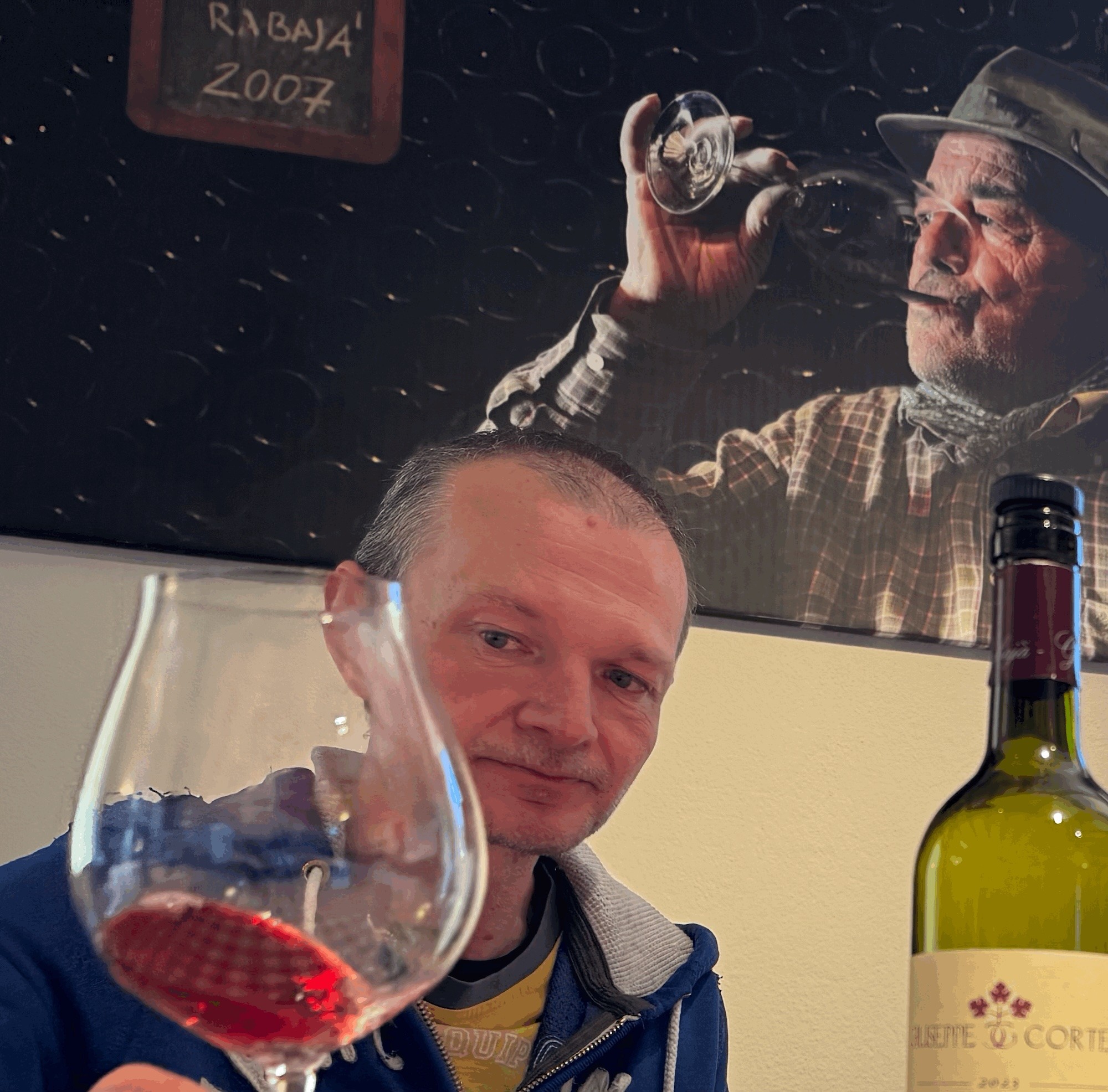
The Rabajà Barbaresco takes you to the highest levels, the deepest valleys, and the longest finish.
Explore Giuseppe Cortese Rabajà Barbaresco 2022.
Availability can change. If the 2022 is no longer available, use the listing to confirm the exact wine rather than replacing it with a different Giuseppe Cortese bottling.
Spoken Wines may earn a commission if you purchase through this link, at no additional cost to you.
A family’s story, captured in a glass
Giuseppe Cortese did more than start a winery. He trusted that the vineyard where he had spent his childhood could speak to people far beyond Barbaresco.
Tiziana now shares that story from the vineyard deck. Pier Carlo carries it into the cellar. Gabriele serves as a bridge between the family’s history and the people discovering its wines around the world.
What began with Giuseppe’s quiet courage has become a family legacy, but it has never lost its connection to the modest house among the vines.
That connection is what makes the Rabajà Barbaresco memorable. You are not simply drinking Nebbiolo from Piedmont. You are tasting one family’s interpretation of the vineyard that raised them.
Learn more about the Cortese family and its wines through the official Giuseppe Cortese website.
The Cortese family’s Rabajà story offers a different perspective on Nebbiolo from our unexpected visit with the Ghisolfi family in Barolo. Both families work with Nebbiolo, but their vineyards and stories show how profoundly place can shape the grape.
Giuseppe Cortese is also part of the Piedmont chapter in our guide to the most important wine regions in Italy. The guide places Barbaresco alongside Barolo, Tuscany, Valpolicella, Sicily, and Alto Adige, helping readers decide where to begin exploring Italian wine.
Continue exploring the country through our Italy page.
For more firsthand reports from the vineyards and cellars we visit, subscribe to the Spoken Wines newsletter.
More from this country

Italy
The Most Important Wine Regions in Italy, and Where Should You Start?
A traveler's guide to the regions, producers, and stories that make Italian wine easier to understand

Italy
Why Daniel Sigmund’s Alto Adige Mountain Wines Taste So Fresh
A first-generation winemaker turns the steep vineyards of the Eisack Valley into Silvaner, Riesling, and Pinot Noir defined by freshness, elegance, and place.

Italy
900 Years Later, This Winery Is Still Making Some of Italy's Most Remarkable White Wines
How Abbazia di Novacella has balanced centuries of tradition with wines that still feel vibrant, fresh, and unmistakably Alpine.



From Vineyard to Inbox
Subscribe to our newsletter