Who Were the Barolo Boys? The Barolo Revolution Behind Ghisolfi
How a rebellious generation of Piedmont winemakers changed Barolo—and how Attilio Ghisolfi carries that legacy forward in Monforte d’Alba.
Jan de Weerd - Spoken Wines
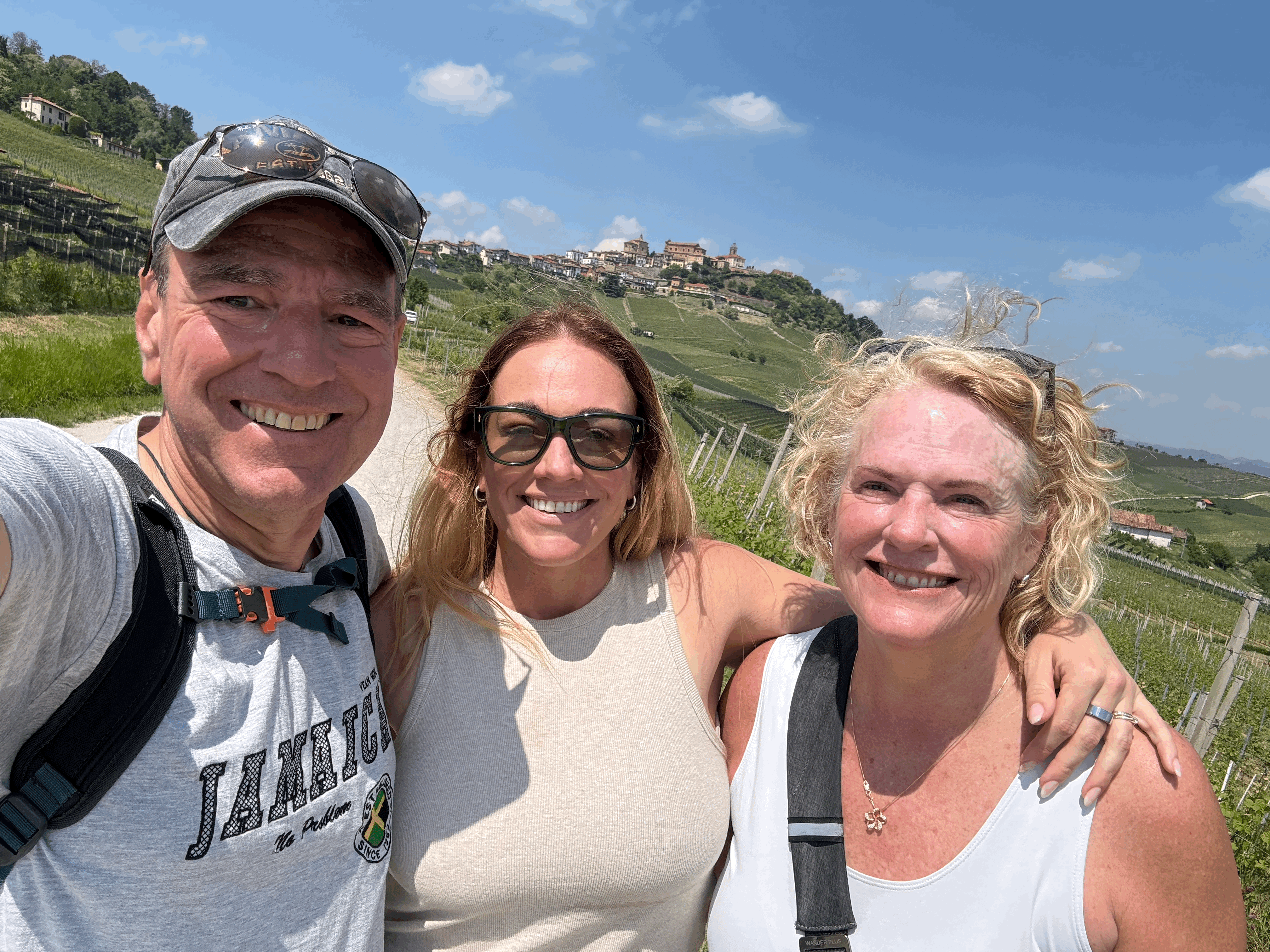
This will hide itself!
Who were the Barolo Boys? They were a loose generation of young winemakers who helped transform Barolo during the 1980s. They were not a formal organization, and they did not follow one identical winemaking method. What connected them was a willingness to question inherited assumptions, experiment with a more modern style, and carry Barolo beyond Piedmont to a wider world.
Their influence was larger than any single cellar technique. They brought confidence, momentum, and international attention to a region whose wines had often remained difficult for outsiders to understand. The conversation they started between tradition and modernity continues in Barolo today.
For the Ghisolfi family, that period became a turning point. The family had grown fruit and grapes for generations, producing only small quantities of bottled wine. As Barolo’s reputation began to grow, they converted their orchards into vineyards and committed themselves more fully to Nebbiolo and Barbera.
We understood that history through a completely unplanned visit to Attilio Ghisolfi in Monforte d’Alba. What began as a happy accident became a firsthand encounter with one family’s place in modern Barolo.
Our accidental meeting with Attilio Ghisolfi
It was the day before Mother’s Day, and we were exploring Monforte d’Alba in the Barolo wine region of Piedmont. Our daughter had flown over from South Africa to join us for the week, supporting our Spoken Wines Italy discovery tour and helping us find the stories behind the wine.
On a sunny but breezy day, we stumbled upon the Attilio Ghisolfi winery. We were greeted by a beaming father doing yard work and an even happier dog who made us feel like her long-lost friends.
We had discovered more than a friendly winery. We had uncovered a living chapter in the modern Barolo story.
And, as it turned out, one of our most enjoyed Barolo wines had been produced right there.
Fate? Maybe.
Serendipity? Definitely.
The connection to the Barolo Boys becomes clearer through the Ghisolfi family’s own turning point. Until the 1980s, the family were fruit farmers who made small quantities of wine for personal use. As Barolo’s reputation grew, they tore out their orchards and planted Nebbiolo and Barbera instead, committing themselves to the region’s new future. Every year in Monforte, they celebrate with Barolo Boys in Fuorigioco, a day of soccer and wine hosted by 45 town producers, Ghisolfi proudly among them. The rebel spirit lives on, with joy, unity, and a good glass to follow the game.
Every year in Monforte d’Alba, local producers celebrate Barolo Boys in Fuorigioco with soccer, wine, and community.
Learning from the land and from Dad
Winemaking at Ghisolfi is a generational conversation. Gianmarco and his son Davide work side by side, connecting decades of experience with the willingness to keep learning.
“It’s like school,” Davide told us. “I learn something new from him every day.”
That grounding in tradition has not prevented the family from evolving. They moved away from barriques toward large botti and tonneaux, making more room for Nebbiolo’s natural elegance to show through. Their methods have changed, but the vineyard remains the center of the conversation.
During our visit, the family described approximately eight hectares of vineyards, with about half devoted to Barolo and much of the remaining land planted to Barbera. Bussia, Visette, and the family’s classic Barolo blend reveal different expressions of soil, elevation, and place.
The classic Barolo brings together Nebbiolo from Monforte d’Alba, Castiglione Falletto, and La Morra. Monforte contributes structure and power, while the neighboring villages bring aromatic lift and finesse. Each parcel is handled according to its character, with careful maceration, native yeast fermentation, and patient aging.
The clearest expression for us was the Barolo Bussia, made from Nebbiolo grown in the Bussia cru of Monforte d’Alba. It carried the strength we expected from the place, but also the refinement that comes from a family willing to learn from each generation.
During our visit, the Ghisolfi family described approximately eight hectares of vineyards, with about half dedicated to Barolo and much of the rest planted to Barbera.
Barolo with a smile and a wagging tail
What stayed with us, besides the wine, was the joy.
A winery visit often comes with a plan and a mission, but this was pure serendipity. It was the day before Mother’s Day, and we were exploring Monforte d’Alba with our daughter, who had flown from South Africa to join our Spoken Wines journey through Italy.
We arrived on a sunny but breezy Saturday afternoon. A beaming father was outside doing yard work, and the family dog greeted us repeatedly as though we were long-lost friends.
Davide welcomed us without pretense and poured us through the portfolio. He explained the vineyards, why he had chosen to join his father, and how their winemaking continued to evolve.
The standout for us was the Barolo Bussia. It carried the legacy of the family’s pivotal shift in the 1980s. The wine was expressive and bold, but refined rather than forceful. As we tasted it, three words came to mind: “Earth, Wind, and Fire.”
It left enough of an impression that we shipped a case home to Idaho.
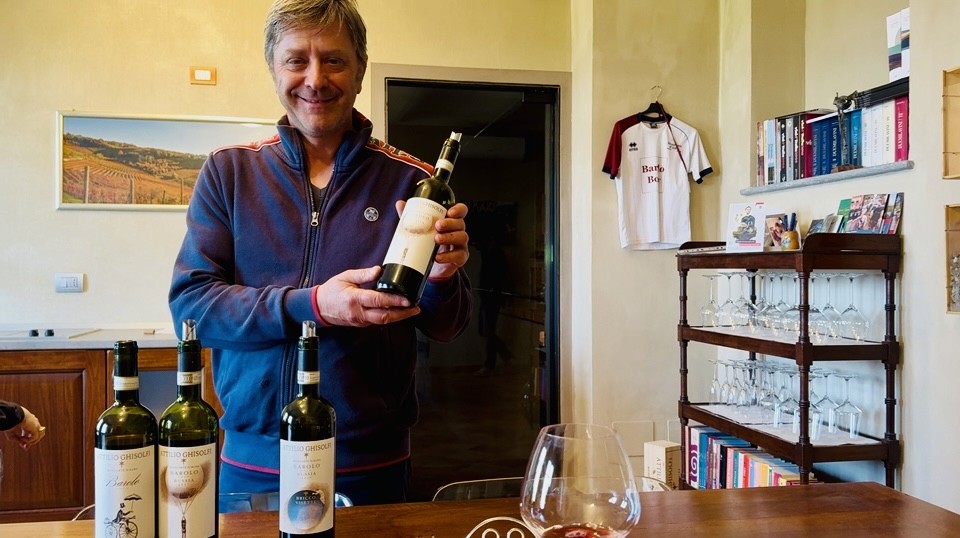
The standout for us was the Barolo Bussia, expressive and bold, but refined. It reflects the family’s pivotal shift toward wine in the 1980s.
What to try first at Attilio Ghisolfi
The wine we would look for first is Attilio Ghisolfi Barolo Bussia.
The Bussia is made entirely from Nebbiolo grown in the Bussia cru of Monforte d’Alba. It brings together the structure and depth associated with Barolo and the refinement that emerged as the family reconsidered its work in the cellar.
No dependable in-stock retailer was confirmed during this review. The former WTSO listing now says to contact customer service for availability, and the exact Wine.com listings are sold out. To explore the current Bussia and other Ghisolfi wines, use the official Attilio Ghisolfi wine portfolio. This is a winery discovery and contact route, not a guarantee of online inventory or United States shipping.
Tasting the wines felt like riding a classic Italian bicycle, the symbol that appeared on the label of the family’s classic Barolo.
There is a saying in Italy: “Se vuoi partire, sali in bici e pedala.” If you want to go, get on the bike and pedal.
That spirit of momentum, driven by heritage, passion, and a touch of rebellion, is what gives the Ghisolfi story its charm. The family did not abandon its past. It climbed onto the bicycle and carried it forward.
To see how another Piedmont family expresses Nebbiolo through a single vineyard, continue with our visit to Giuseppe Cortese and the Rabajà vineyard in Barbaresco.
Attilio Ghisolfi is part of the Piedmont chapter in our guide to the most important wine regions in Italy, where Barolo and Barbaresco sit alongside Tuscany, Valpolicella, Sicily, and Alto Adige.
Visit our Italy page to continue exploring the regions, people, and wines that make Italy easier to understand.
For more firsthand stories from the vineyards and cellars we visit, subscribe to the Spoken Wines newsletter.
More from this country

Italy
The Most Important Wine Regions in Italy, and Where Should You Start?
A traveler's guide to the regions, producers, and stories that make Italian wine easier to understand

Italy
Why Daniel Sigmund’s Alto Adige Mountain Wines Taste So Fresh
A first-generation winemaker turns the steep vineyards of the Eisack Valley into Silvaner, Riesling, and Pinot Noir defined by freshness, elegance, and place.

Italy
900 Years Later, This Winery Is Still Making Some of Italy's Most Remarkable White Wines
How Abbazia di Novacella has balanced centuries of tradition with wines that still feel vibrant, fresh, and unmistakably Alpine.



From Vineyard to Inbox
Subscribe to our newsletter